Joshua Tree National Park During the Shutdown

Recap: After a lot of consideration, I decided to visit Joshua Tree National Park with my dog during the 2025 government shutdown. Here, I discuss what the park is like and how to determine whether visiting national parks right now is right for you.

Visiting a National Park During a Government Shutdown

I realize that visiting a national park during a government shutdown can be a controversial decision. There are reasonable arguments why you shouldn’t do so. Many argue that visiting during a shutdown can lead to overflowing trash, damaged resources, and unsafe situations because staff aren’t being paid or are working limited hours.

I typically drive through parks rather than hike off of the main roads since I travel with my dog, and I would never take her anywhere dogs aren’t allowed. I am used to packing up my own trash from camping, so if trashcans weren’t available, I would never leave my trash in a park. I would be prepared for the possibility that facilities wouldn’t be open. I made the decision to go, as I had been planning a fall visit to Joshua Tree all year, and I determined that I would not be putting myself in unnecessary danger or harm the park in any way.

Here are some things to keep in mind if you visit a national park during the shutdown:

  • Facilities may not be open at all, so figure out a plan for your basic needs of food, water, and restrooms. You can find my favorite product for peeing on the go in this post here!
  • Have trash bags and be prepared to pack your trash out, not leave it behind.
  • Don’t break the rules. Don’t go off trail. Don’t take your dog places where they aren’t allowed. Don’t poach people’s campsites (I discuss more about dogs in the park and the reservation system below).
  • Be kind. If you see park rangers, realize that this is a challenging time and they may be working without pay. Be polite and grateful to be there.

With these things in mind, I set out to explore Joshua Tree in mid-October 2025.

Joshua Tree during a shutdown

Although entry fees aren’t being collected, the entrance gates were staffed, and rangers were available and friendly. It really felt like business as usual. All of the park rangers I spoke to were very friendly and helpful.
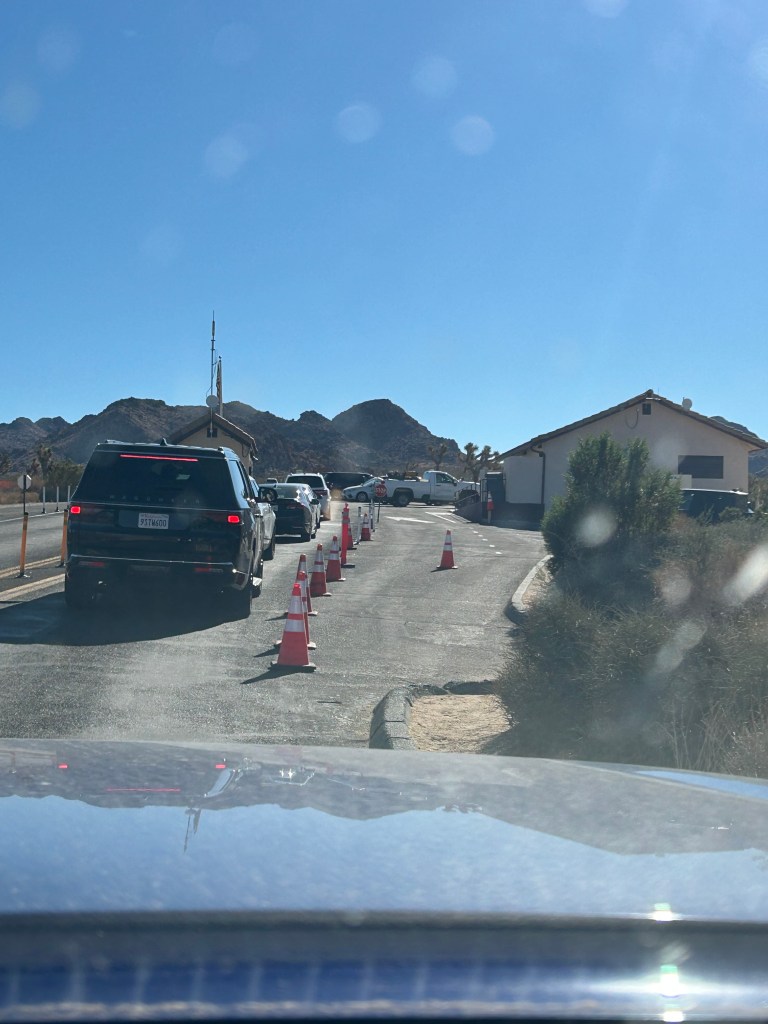
The line ahead and behind me to get in. Please ignore my criminally dirty windshield.

The campgrounds are open. You can still make reservations through recreation.gov, and by all accounts, pit toilets are clean and maintained, and trash is being emptied. I stopped at a couple of restrooms during my drive through the park and they were all clean with plenty of toilet paper.

Joshua Tree was active when I visited on a Friday morning. There were plenty of people enjoying the scenic views as well as camping and hiking throughout the park. I noticed quite a few international visitors, a reminder that this park draws people from all over the world.

park fees

As I mentioned, no fees are collected during a shutdown. This can be incredibly detrimental for the parks as they have millions of visitors every year and require tons of care and upkeep. Without entrance fees, maintenance and conservation efforts can quickly fall behind. If you visit a park during a shutdown, consider donating to a non-profit that benefits the park, such as the Joshua Tree National Park Association (link). The visitor center near the west entrance remained open, with restroom facilities and plenty of cute merchandise available. Consider supporting the parks by purchasing something or making a monetary donation to the Joshua Tree National Park Association.

history of the park

Joshua Tree became a national park in 1994 after being protected as a national monument in 1936. Named after the iconic Joshua Trees that populate the park and surrounding area, the park covers parts of the Mojave Desert and the Colorado Desert. Joshua Trees are a delicate part of the ecosystem and face threats due to climate change such as increasing temperatures and decreased rainfall in the area.
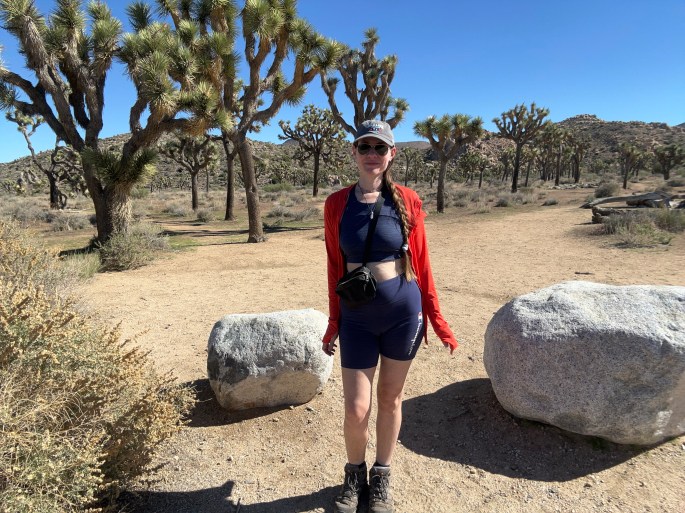
A woman standing among the Joshua Trees at Joshua Tree National  Park during the shutdown

Among the famous Joshua Trees

The area encompassing the park has a history of mining operations for copper, zinc, iron, and gold. A wealthy resident of the area, Minerva Hoyt, petitioned the government to protect the area, leading to its eventual designation as a national monument.

my visit to the park

A woman at Joshua Tree National Park during the government shutdown

Yeah, I couldn’t stop taking pics with the Joshua Trees

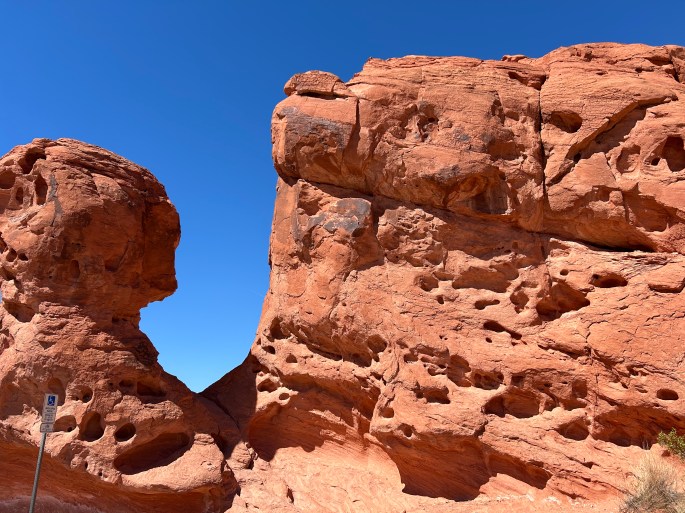
When I visited the park, I came in through TwentyNine Palms and the west entrance. Even simply driving through the area exposes you to otherworldly desert beauty. There are rocky formations among the trees and many people come to the area to rock climb.

keys view

I drove to Key’s View which overlooks the Coachella Valley and Palm Springs. This was an incredible view, and is a great spot for stargazing in this Dark Sky Park. There are several parking spaces and it’s just a short walk to the viewpoint.
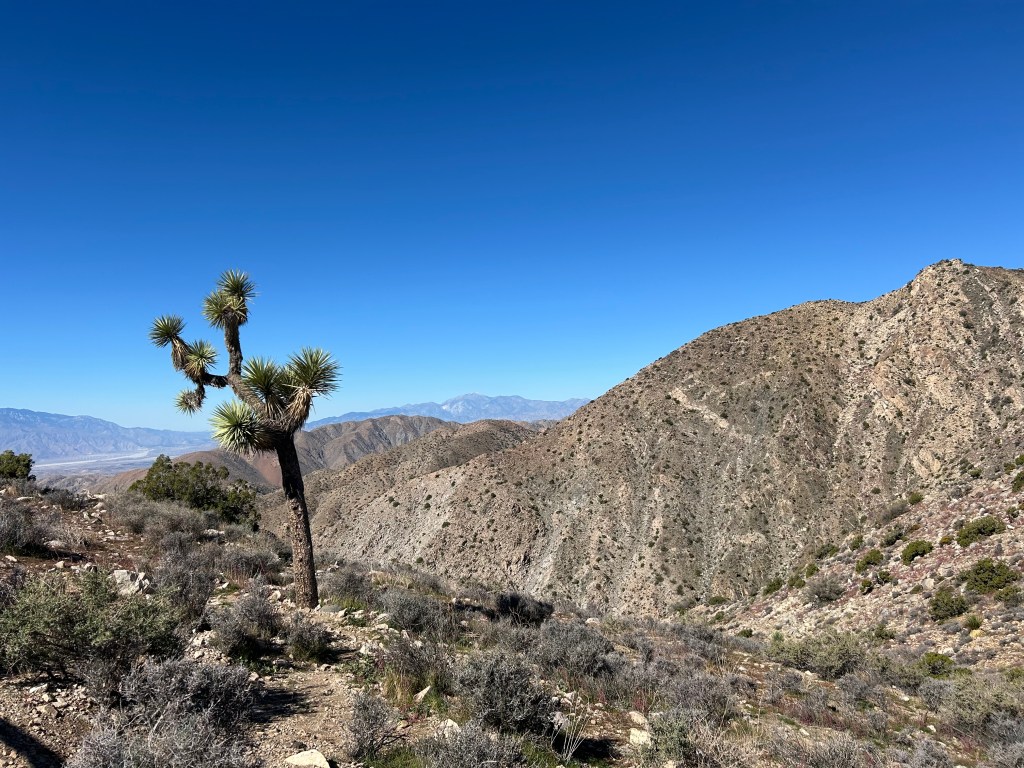
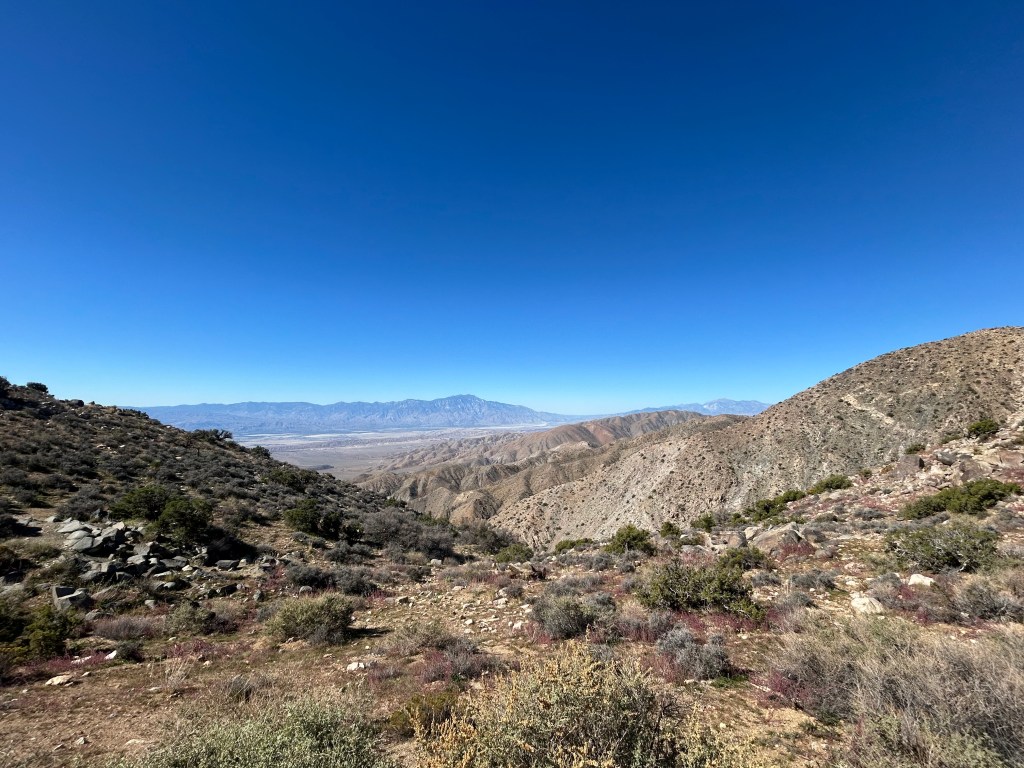
Keys View is magnificent!

cholla cactus garden

I continued driving into the southern area of the park that consists of the Colorado Desert and found one of my favorite areas of the park, the Cholla Cactus Garden. They’re just so cute and fluffy-looking, although you do NOT want to touch them! Apparently it’s very easy to get the painful spines stuck in your skin! There’s a parking area and a short trail leading through the cactus garden so you can wander among them.
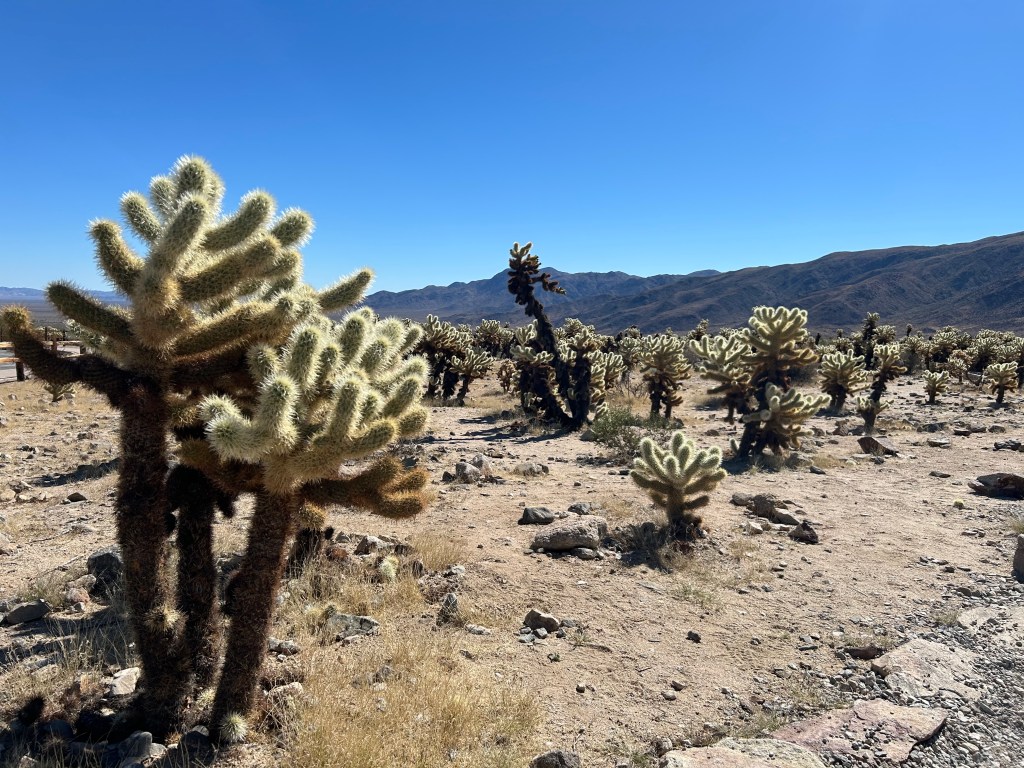
See, they’re so cute!

Selfie at Cholla Cactus Garden at Joshua Tree National Park during the government shutdown

Repping the Texas State Park hat wherever I go

dogs in the park

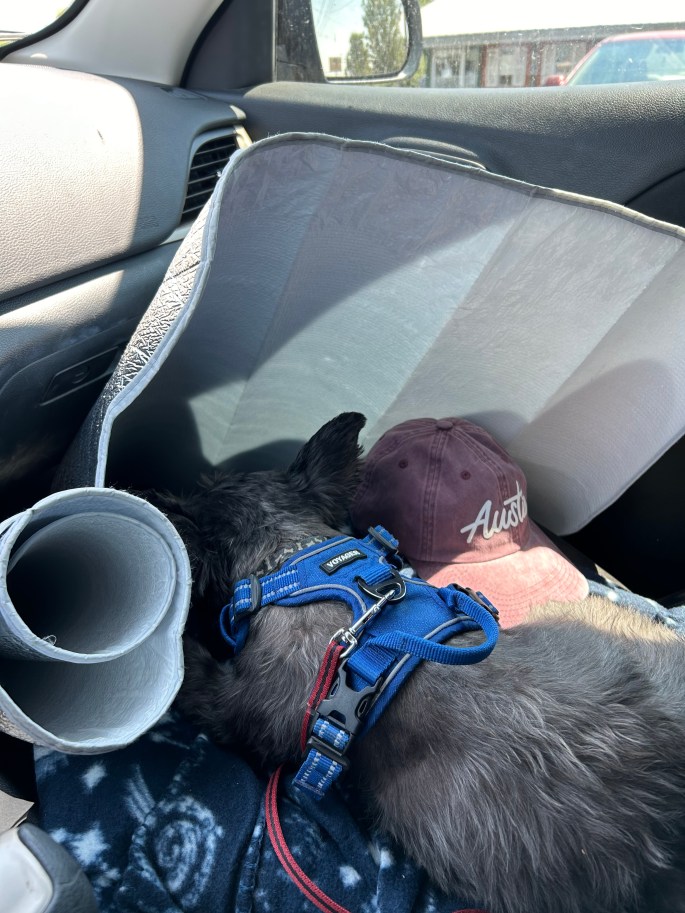
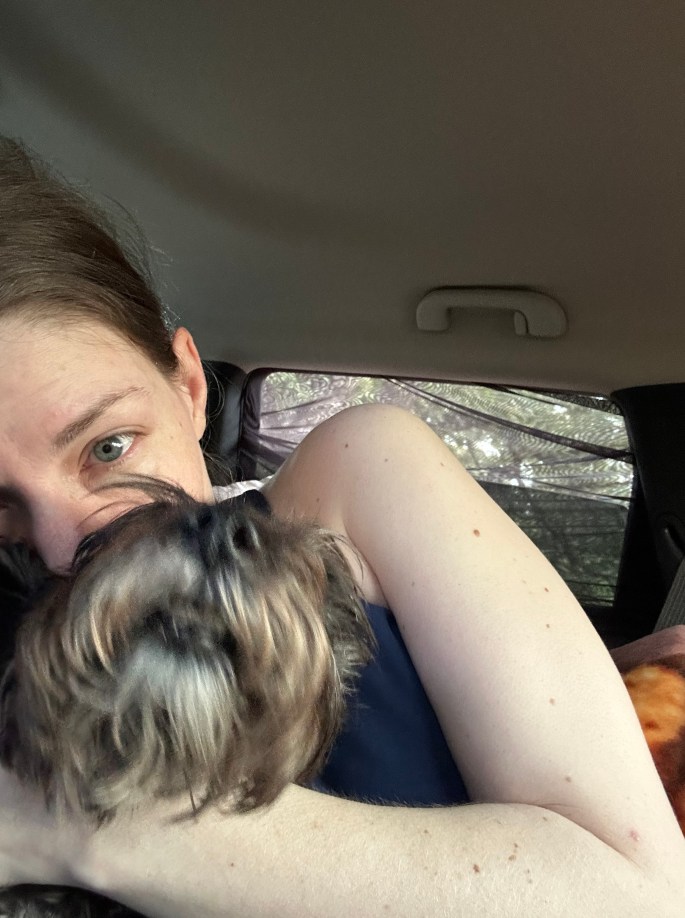
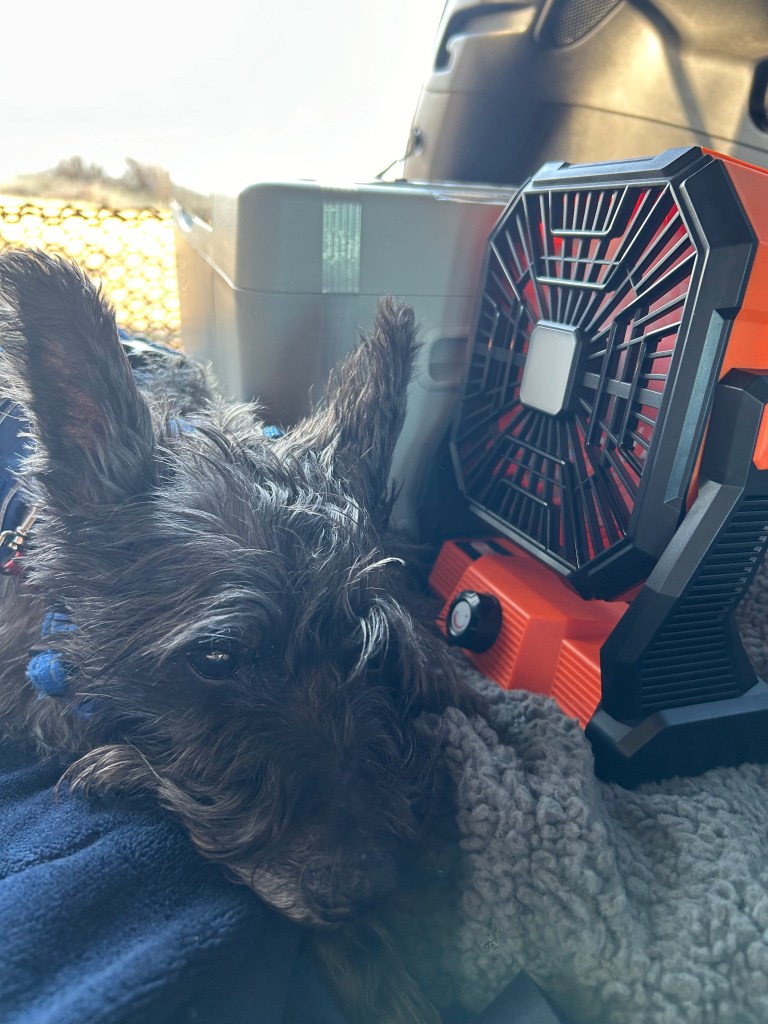
Like most national parks, Joshua Tree isn’t very dog-friendly. Dogs aren’t allowed on trails or in the backcountry. They’re limited to roads, parking areas, and campgrounds, and must stay within 100 feet of those areas while on a leash. I kept Beatrix in the truck with me while I drove through the park. Of course, she hardly minds napping while I drive through these beautiful places.

outside the park

There are other places you can see the Joshua Trees outside of the park, like Mohave National Preserve. I drove through part of the preserve on my way to the park, and it was beautiful and contained many Joshua Trees. Beatrix and I stayed for two nights at the Joshua Tree Lake RV and campground which is only about a 10 minute drive from the park’s western entrance. With its bathrooms, showers, dog park, RV hookups and plenty of spaced out tent camping spots, we loved staying there. It just has a friendly, funky desert vibe and I’d definitely stay there again if we go back.
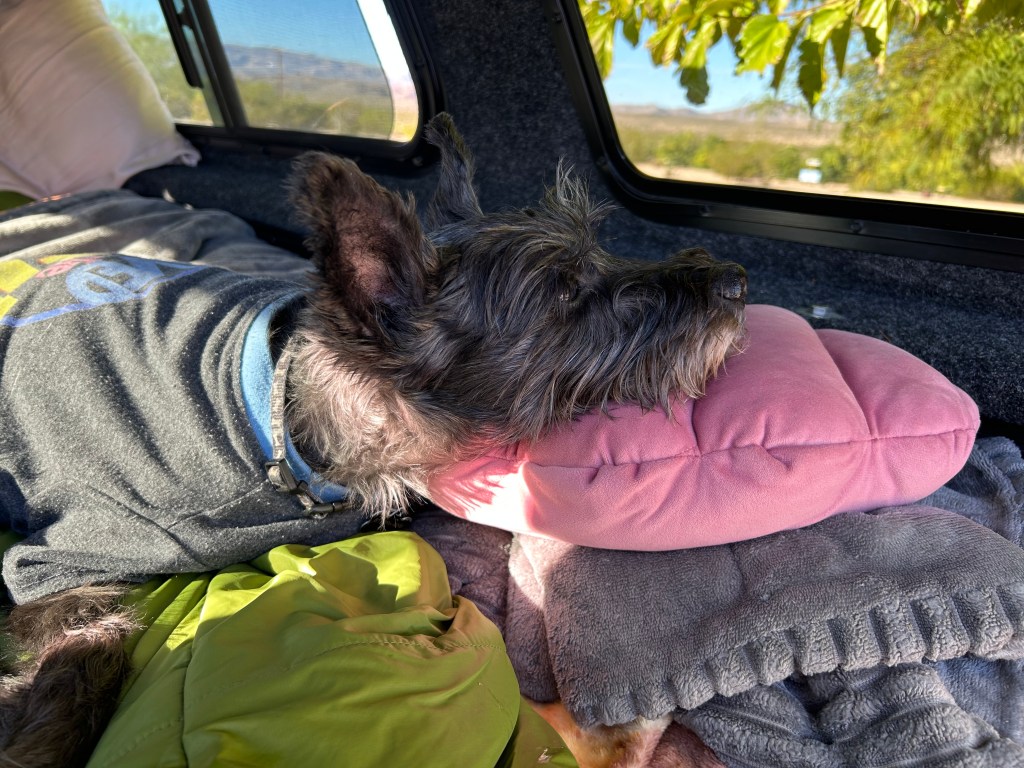
She loves lying on pillows like this

A mile or so past the Joshua Tree Lake campgrounds you can stop and see a sculpture called “Transmission.” It’s on private land, but there is a little fenced off public path where you can get closer to take pics. It’s weird and cool, which definitely fits the Joshua Tree vibe.
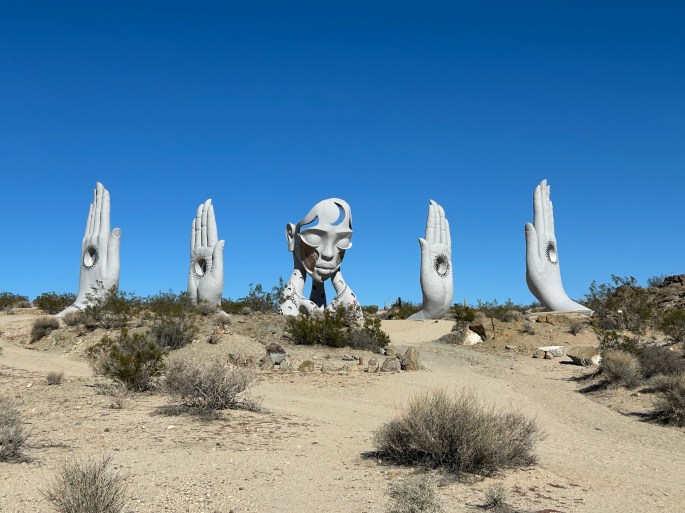
Transmission sculpture near Joshua Tree National Park

A cool bit of desert weirdness

Visiting a national park during the shutdown is a personal choice, and for me, it was worth it. I’m glad Beatrix and I checked this park off of our list. If you decide to visit as well, please keep in mind how important it is to follow the rules to preserve these fragile ecosystems, and consider donating to ensure the funds are there to do so.

National Park Roundup: Driving Through Death Valley

Recap: I visited the country’s hottest and driest national park on a road trip with my dog, driving through miles of desolate, flat desert surrounded by mountain ranges. You can read about my experiences at Zion National Park with my dog here.

History

The national park, covering areas of California and Nevada, stretches over 5,000 square miles of the vast Death Valley. It was designated as a national monument in 1933. At that time the area contained the homeland of the Timbisha Shoshone Tribe, and a reservation was not designated for these people until 1982. Death Valley gained national park status in 1994.

The “Death” in Death Valley

Death Valley gets its spooky name from gold rush pioneers heading to California who thought the area would be their tomb in the winter of 1849. When they were rescued and leaving the area, one of them apparently said, “Goodbye, Death Valley,” and the name stuck.

People have lost their lives in the park, with the most common reason being vehicular accidents, and some people have lost their lives due to heat exposure. Temperatures in the hottest place on earth can soar as high as 120 degrees Fahrenheit, with the record high temperature reaching 134 degrees Fahrenheit.

Death Valley National Park thermometer

When I visited in April, it was only a cool 87 degrees.

Death Valley National Park Furnace Creek Visitor Center

Furnace Creek Visitor Center

Driving Through

Death Valley is a great national park for driving through. Its unique desert landscape stretches for miles, crossing some of the west’s most remote areas.

I entered Death Valley from the east, driving in from Las Vegas through Pahrump and Death Valley Junction, then continued west through Furnace Creek and Panamint Springs on my way to Bishop, California, which I wrote about here.

One famous site is Badwater Basin, which is 282 feet below sea level, consisting of nearly 200 square miles of salt flats made up of salt, calcite, gypsum, and borax. Tens of thousands of years ago this was the site of the ancient Lake Manly, which is now completely evaporated, leaving behind the Badwater Basin.

One of the most popular spots in the park to stop and take in the view is Zabriskie Point. This location is where you can access the start of the Badlands Loop Trail from the parking lot. I had initially put Zabriskie Point on my list to check out, but as I approached the area, I decided to just drive on past. It was pretty crowded, with a line of cars going in and out of the parking lot, and it was crawling with tourists. Not that I have anything against tourists…I realize that most places I go, I’m the tourist! But sometimes when I’m in the middle of a road trip like I was here, the thought of getting to my next stop is all the mental energy I have, and I just don’t want to take the time to futz with a busy crowd.

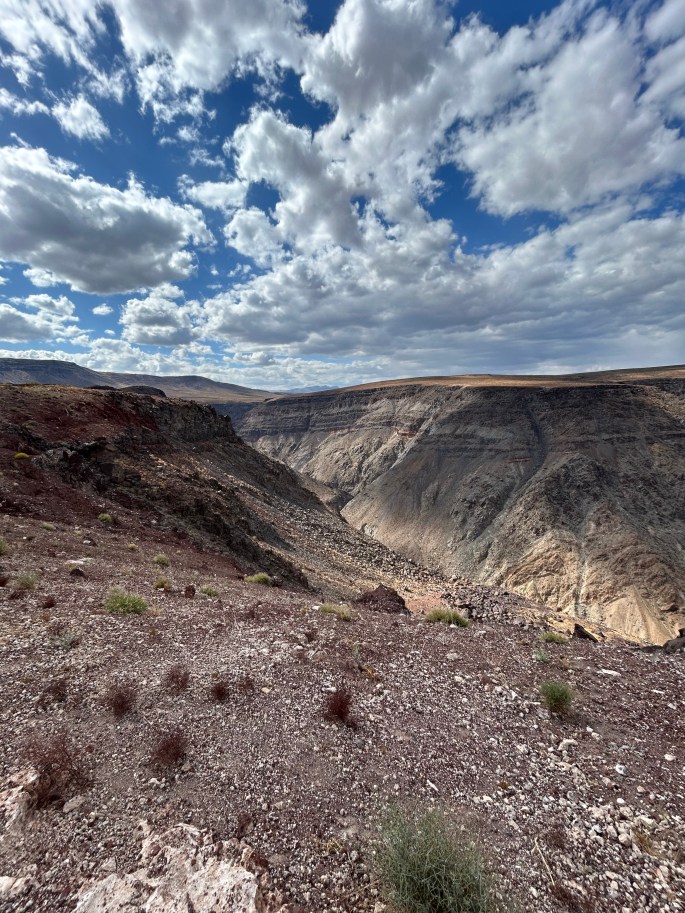
I did stop at the Father Crowley Vista Point with its views of Rainbow Canyon, where military fighter jets used to train. It’s located near the park’s western edge, overlooking Rainbow Canyon.

Rainbow Canyon at Death Valley National Park

Rainbow Canyon, also known as Star Wars Canyon, was once a training site for fighter jets.

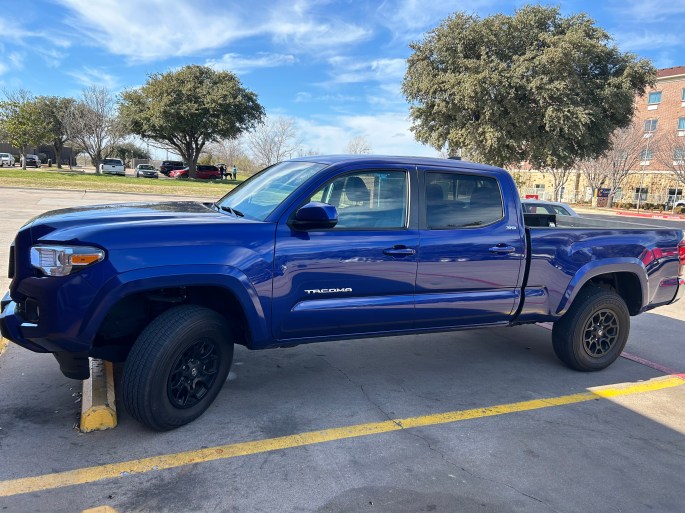
Toyota Tacoma at Father Crowley Vista Point at Death Valley National Park

My traveling Tacoma at Father Crowley Vista Point.

Dogs

Pets are not allowed on any trail in Death Valley NP. There are no dog-friendly hikes available in Death Valley. That works for me and Beatrix, because she’s a little old lady who doesn’t really go on hikes and is content to be a passenger princess for the duration. But for many people who have active dogs, this is limiting.

Like all national parks, dogs are allowed on parking lots and paved roads only.

The National Park Service published this list of roads near popular Death Valley sites where you can walk your dog.

Death Valley was a memorable drive through some gorgeous country, and I’m glad I passed through on my way to continue my road trip west!

National Park Roundup: Exploring Zion with my Dog

Recap: I explored Zion National Park with my dog, drove the scenic roads, and was tempted to join the boondockers camping just outside the park.

A Little History

Zion National Park, Utah’s first National Park, was established in 1919 by President Woodrow Wilson after first being protected as a national monument. It’s one of the most popular national parks; according to the National Park Service, attendance has increased 90% since 2010. In 2021, more than 5 million people visited the park, which is an impressive milestone few national parks ever reach.

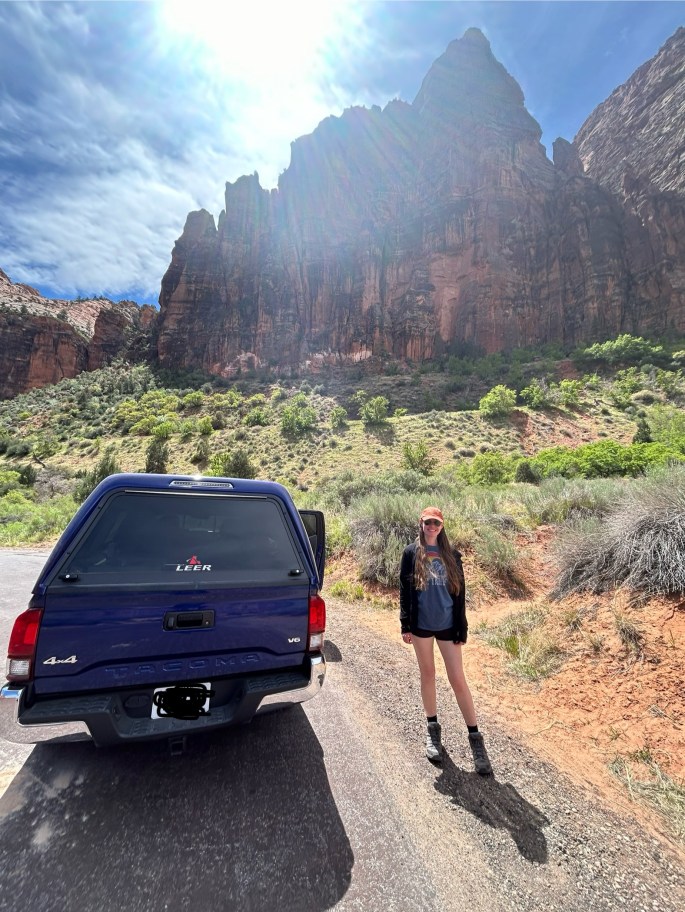
Traveler with Toyota Tacoma in front of Zion red rock cliffs

Zion’s red rock cliffs are breathtaking, even from the roadside.

How to Drive Through Zion (Even When Shuttles are Running)

Zion Canyon Scenic Drive is closed to private vehicles when shuttles are running. Due to the enormous number of visitors to the park, a shuttle system is used to ensure as much access as possible. Most years the shuttles run from March to November, and for the holidays near the end of December. When I visited in April, this road was closed, and I couldn’t access that portion of the park. That means I missed out on famous sights such as the Narrows and Angels Landing.

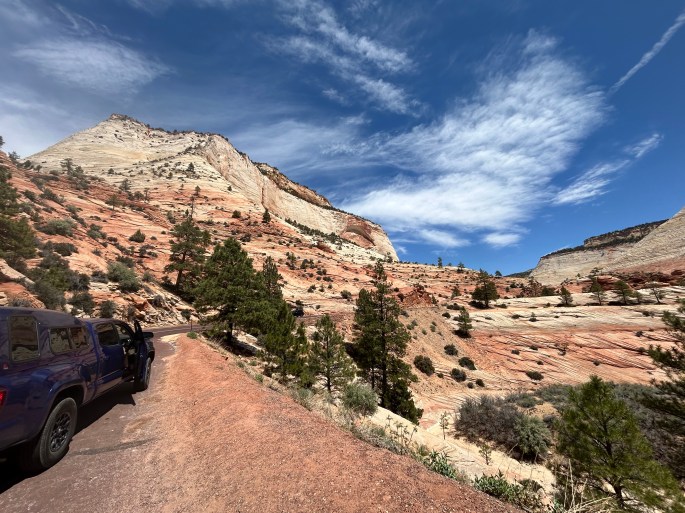
Zion National Park road winding through red cliffs under blue sky

Even if you can’t drive through the whole thing, the views are still jaw-dropping.

Even when the shuttles are running, you can still drive through on the Zion-Mt. Carmel highway, the Zion-Mt. Carmel tunnel, Kolob Terrace Road, and Kolob Canyons Scenic Drive. While the tunnel accommodates most vehicles most of the time, oversized vehicles may need to apply for a special permit. I drove through the tunnel and it was very cool!

Zion National Park road winding through red cliffs under blue sky

Pull-off views like this make the drive unforgettable.

Visiting Zion with a Dog

Zion is not the easiest park to traverse with a dog. Like most national parks, dogs aren’t allowed in a majority of the park. They’re also not allowed on shuttles, so a whole section of the park is off-limits if you bring your furry friend.

Dogs are usually allowed in areas around national park visitor centers, and the same is true for Zion; dogs are allowed on the paved Pa’rus Trail that you can access from the visitor center. However, as Zion is an extremely popular destination, it can be difficult to even find a place to park at the visitor center to let your pup run around a bit. Beatrix and I finally did find a spot at the visitor center, but it was at the end of our excursion, after we’d already driven around most of the park. I stopped in briefly and picked up a park patch.

Zion Canyon Visitor Center building with red rock backdrop

Worth a stop if you can find parking!

I love a national park that allows you to see much of its beauty on a drive through. That’s probably the thing I value most when traveling with a dog. Another Utah-area park that I think is even better than Zion for driving through with a dog is Bryce Canyon. You can drive to almost any area in the park, and there are dozens of pull offs with gorgeous views. When I visit places like that, I tend to leave Beatrix in the truck, running with the air conditioner on of course, and dash out for some quick pics.

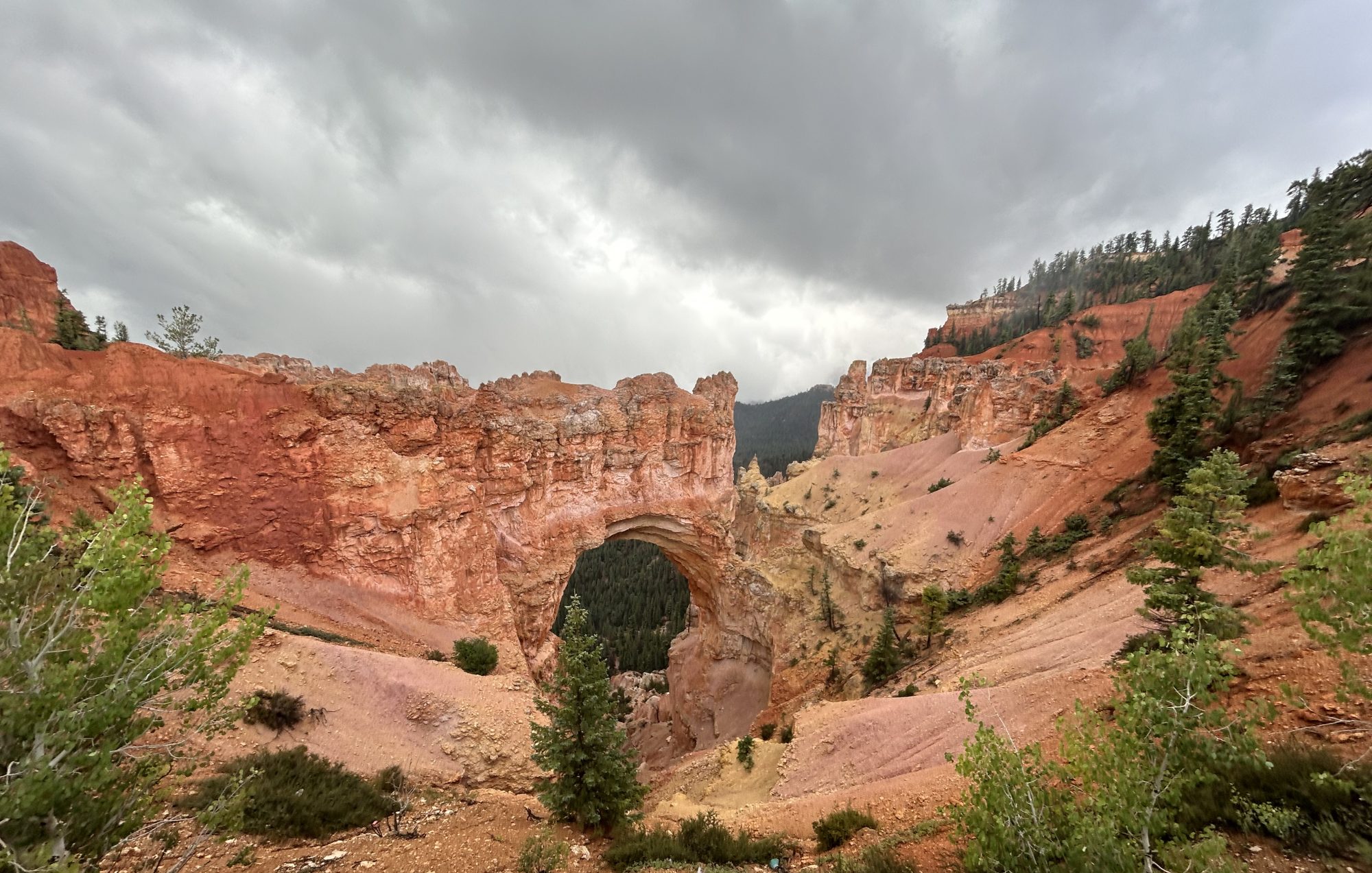
Selfie at Bryce Canyon, overcast skies

A rainy day during my visit in 2024 made Bryce Canyon even moodier and more magical.

Because I could only drive through some of Zion, I felt like I was missing out on a lot of what the park had to offer, and it’s on my list as a park I’d like to visit in the future if I’m making some dog-free trips. Still, if you’re in the area, and especially if you have a park pass, it’s definitely worth stopping by and checking out the majesty this place has to offer.

Where to Camp Near Zion

Camping is available within the park, but it can be difficult obtain a reservation, especially in peak season. If you’re like me, you’re always on the lookout for some free camping on BLM or National Park land anyway. Something I noticed as I approached the entrance to Zion were all of the boondockers parked throughout the beautiful lands surrounding the park. If I return, I’m definitely going to find some free camping in the area. The park’s boundaries certainly don’t enclose all of the unique beauty of the area, and there are plenty of quiet, scenic spots to camp outside the park boundaries.

Final Thoughts

Even though I couldn’t access the whole park with my dog, Zion’s drive-through beauty made it worth the visit. Next time, I might come back dog-free to hike The Narrows or Angel’s Landing…but for now, it’s a must-stop if you’re road-tripping through southern Utah.

Desert Magic: Homolovi State Park and Route 66 in Winslow, AZ

One of my favorite road trip stops this year was Homolovi State Park and Winslow, Arizona. It’s fairly close to Petrified Forest National Park, which we visited as well, and Flagstaff, Arizona. Winslow is on the old Route 66 and is an adorable small town with lots of charm. It sits roughly an hour west of Petrified Forest and an hour east of Flagstaff, making it a perfect midpoint stop.

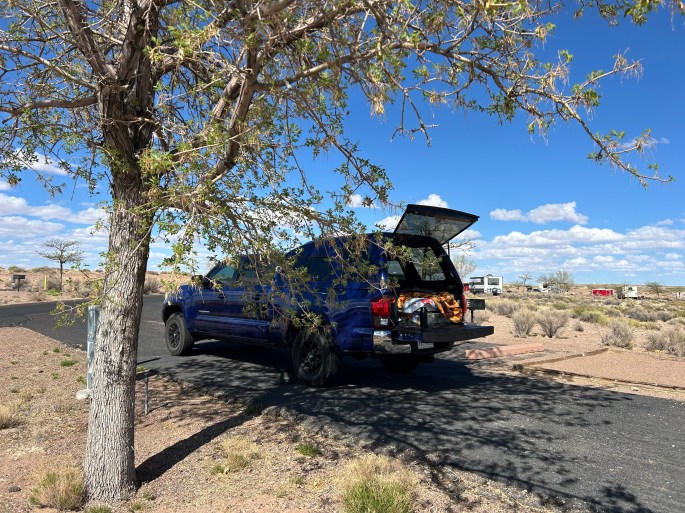
Beatrix and I checked in at Homolovi State Park on an April afternoon. The sun was shining brightly, but our camp spot was miraculously in the shade!

Toyota Tacoma parked under a small desert tree at Homolovi State Park campsite in Arizona

The traveling Tacoma makes it to Arizona!

We had a nice, slow afternoon, and I even realized the tent pad at our spot was the perfect place to put my yoga mat and do a little stretching. By that time we’d been on the road for a few days, and my body definitely felt it.

The weather was perfect in the shade, so Beatrix and I just kicked back and got some rest until it was time to make dinner.

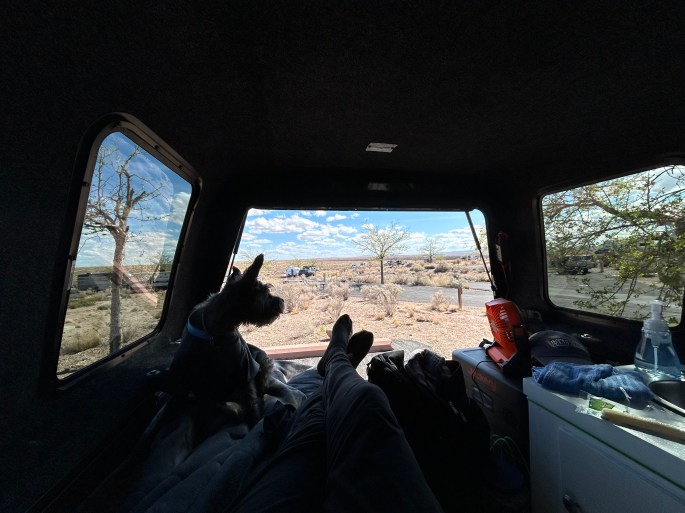
View from the back of a truck camper with a mini schnauzer resting inside and desert landscape visible through the windows

Enjoying the quiet and the desert landscape.

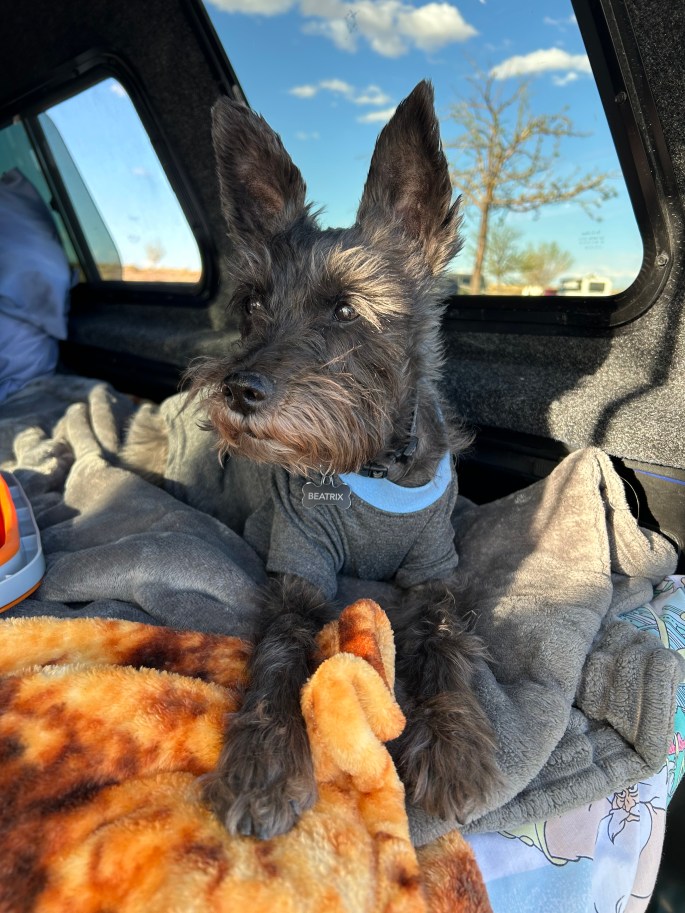
Mini schnauzer lounging in the back of a truck camper during a desert camping trip

Beatrix the mini schnauzer, camping goddess.

At first there weren’t too many other campers, but as it got close to evening, the campgrounds filled up and every spot was taken. I had made a reservation in advance, which I highly recommend for this park; it’s in demand.

There are some major upsides to campgrounds, such as a built-in sense of security (whether true or not) and access to trash and bathrooms. In fact, I usually try to get a spot really close to the bathrooms so I can easily take bathroom breaks and brush my teeth, even though I have a sink in my build. It helps save my water, and it’s always a plus when you can actually flush a toilet. But there are downsides, too. It did feel a little cramped with everyone in there, although most people really keep to themselves. But it can feel a little weird doing all my leg stretching yoga poses and downward dog in full view of like a dozen RVs.
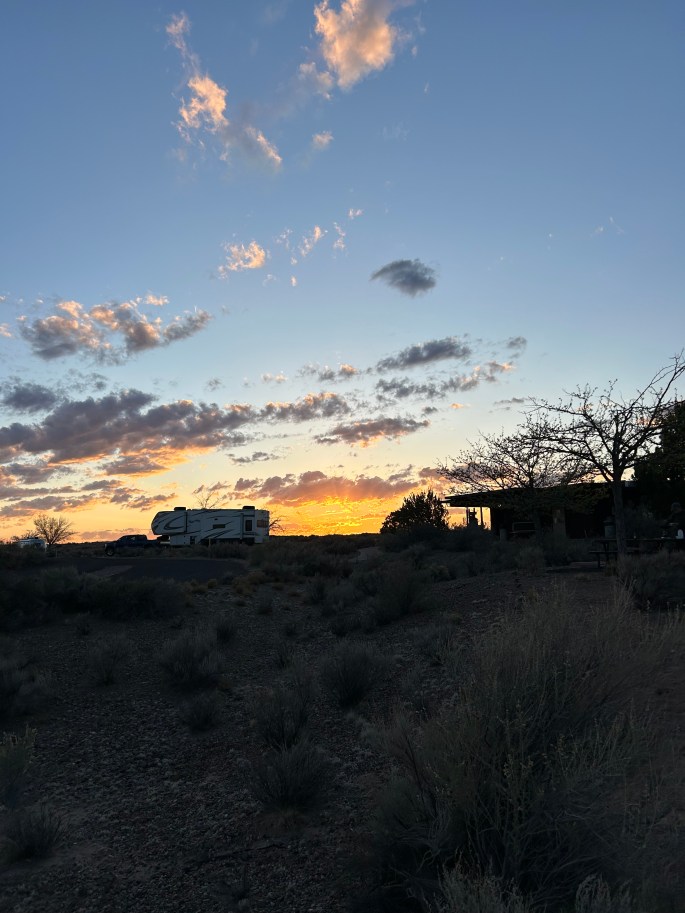
When sunset began, I was speechless.

Glowing golden sunset over the flat Arizona desert at Homolovi State Park

Just breathtaking!

I was really mesmerized by the bright golden light. There is something so beautiful about the flat, vast desert and the endless sky. I’ve always thought tall trees and mountains were my favorite, but doing some desert camping this year has made me change my mind. When it’s not oppressively hot, the desert is one of the most magical places to be.

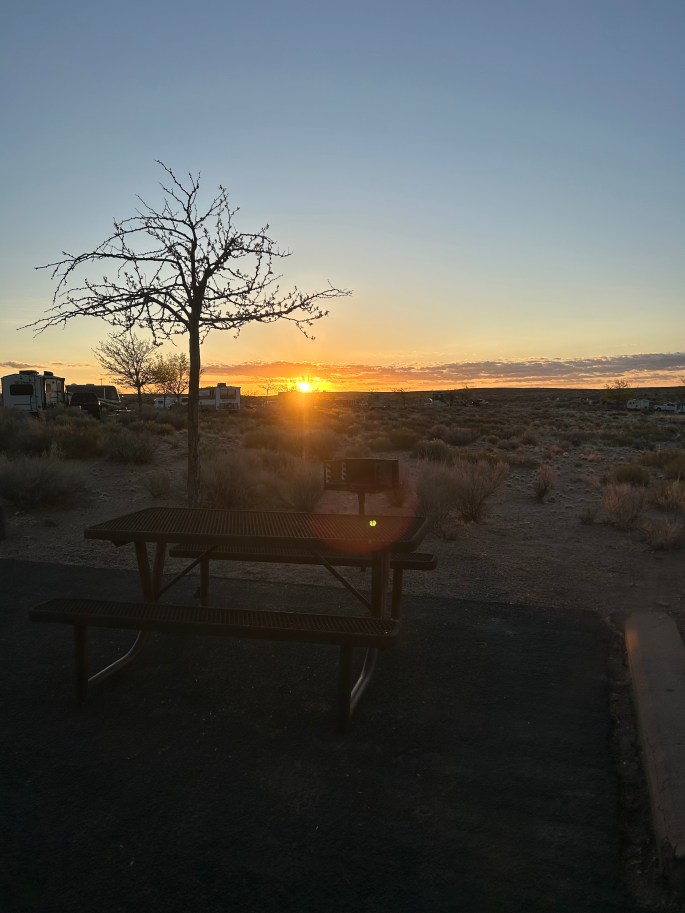
The sunrise was gorgeous too! The sunlight poured into my truck.

Early morning desert sunrise casting warm light over Homolovi State Park campground

It really got me up bright and early!

There are two historical sites at Homolovi State Park featuring the ruins of native structures. According to the official Homolovi State Park website, “Homolovi” is Hopi for “place of the little hills.” The Hisat’sinom, or ancestral Puebloan people, migrated through this area on the way to join the people now known as the Hopi. This area is considered sacred to the Hopi.

I didn’t visit the ruins because my priority when I travel is Beatrix, first and foremost. I don’t like her to get out in the direct sun, and I try to minimize the time I just leave her in the car with the engine running as much as possible, especially in warm places like Arizona. But I’m also torn on seeing some of these things. I feel like such a colonizer tourist traipsing around the remains of a sacred place that was once the homeland of a thriving and ancient culture. Of course, I also think it’s important as a tourist to remember these places and sit with that discomfort as well.

Through the course of my traveling, I’ve realized that some of the most beautiful places I’ve visited are on the grounds of stolen land. I’ve been thinking about doing a deeper post just about that, so stay tuned.

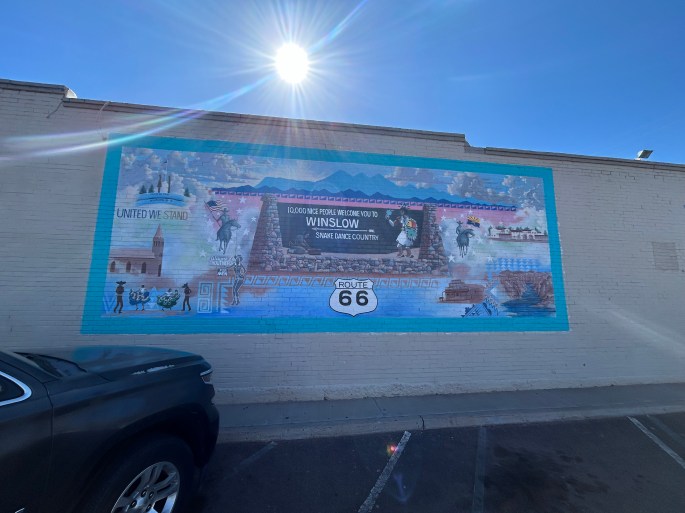
After leaving the state park, Beatrix and I stopped in at the little town of Winslow to get some gas. It’s a small, slow, cool little town, kind of like Bishop, California, which I talked about in my last post.

Mural reading “10,000 nice people welcome you to Winslow” painted on a brick building in Winslow, Arizona

Welcome to Winslow!

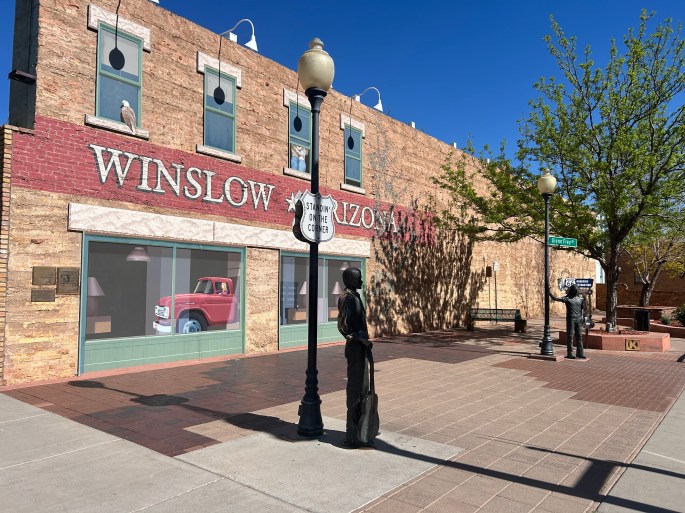
I noticed some signs for Standin’ on the Corner Park, from the famous line from the Eagles song, so I had to make a quick stop.

The “Standin’ on the Corner” statue and mural tribute in downtown Winslow, Arizona on Route 66

Standin’ on the corner in Winslow, Arizona.

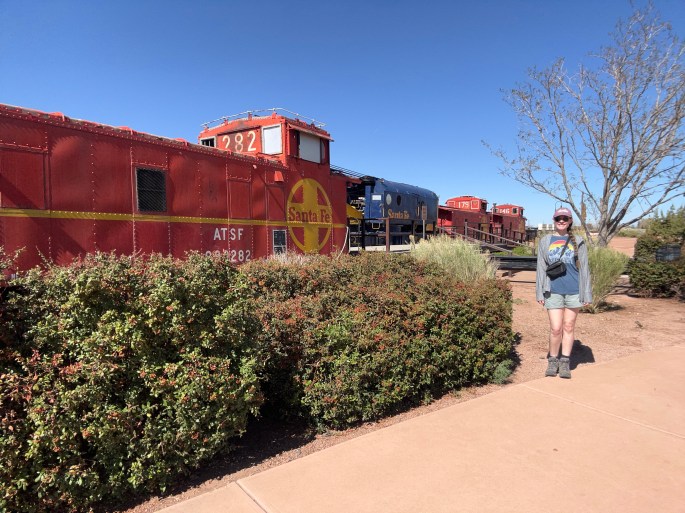
Right near the corner, I spotted a massive vintage Santa Fe train on display, so of course I had to grab a photo!

Traveler standing in front of a vintage Santa Fe locomotive on display in Winslow, Arizona

Classic train moment!

One thing I noticed while driving through all of that big, gorgeous Arizona desert was there are trains everywhere out there. Of course I had to take a pic in front of one when I could! After a peaceful night in the desert and a quick corner stop in Winslow, we were back on the road, next stop: Nevada.

BLM Spot Review: Camping at the Volcanic Tablelands Outside of Bishop, California

One of my favorite free camping spots this trip was at the Volcanic Tablelands, just outside of the adorable small town of Bishop, California. It was perfect for truck camping in my Tacoma.

Getting there:

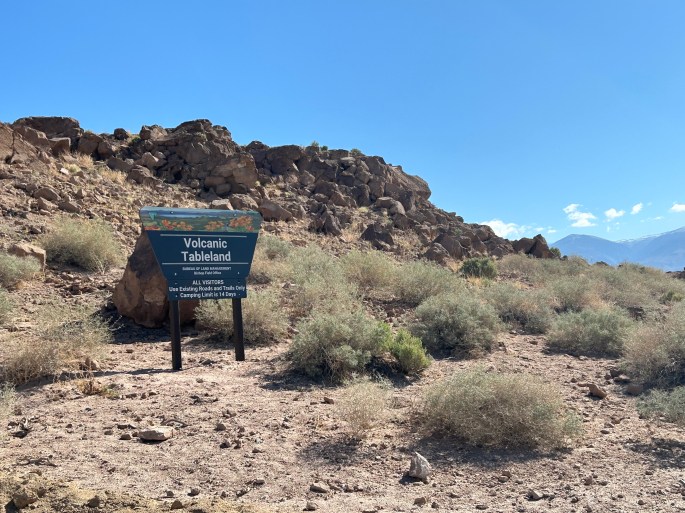
You can access the Volcanic Tablelands by heading north on US 6 out of Bishop, and turning onto Casa Diablo Road. You’ll see a sign marking the area and lots of pull offs for camping.

Entrance sign for Volcanic Tablelands BLM camping area near Bishop, California

You’re here!

camping at volcanic tablelands:

This was my first stop out of the Las Vegas area on my way to Oregon. The weather was perfect—sunny and cool, my favorite—and I had no problem finding the area, which is always a win when venturing into unknown BLM territory for camping. I’m always afraid I won’t find it! The pull offs are obvious and clearly marked with fire rings. I drove past a couple of RVs and found a nice, private open space to park the truck.

Toyota Tacoma truck camper parked on open BLM land with dog sniffing nearby at Volcanic Tablelands

Beatrix got to work right away sniffing the area.

The view of the snow-capped eastern Sierra Nevada mountains combined with the rocky desert was nothing short of stunning.

Snow-capped Sierra Nevada mountains rising behind rocky desert landscape at Volcanic Tablelands

This view was like nothing I’d seen before!

We settled in, made some dinner, and got a comfy night’s sleep in the camper.

Sunrise at Volcanic Tablelands BLM camping
Sunrise view of desert and mountains seen from inside a truck camper

Yep, I woke up to this!

bishop, California:

In the morning, Beatrix and I walked a little, had breakfast, and prepared to get on the road. I decided to backtrack a little way to the town of Bishop, California to get gas and see if I could find a place to fill up my water jugs. Just like Poverty Flats (which I wrote about last week), this area doesn’t have any facilities like restrooms or water so you have to come prepared. I wasn’t out of water, but wanted to top off before getting back on the road.

Camper smiling in front of Eastern Sierra mountain range at Volcanic Tablelands BLM site

I could’ve easily spent more time in this gorgeous area. You can camp here for up to 14 days at a time!

Bishop is an adorable little town. Think, 25 mph main street. I stopped at the dog park to let Beatrix get some more sniff time in.

Sign for dog park in Bishop, California

There were plenty of smells to be found.

Near the dog park is a lovely park with a duck pond and public restrooms. I stopped at the visitor’s center to inquire about filling up my water jugs, and they kindly let me fill up right outside the building (pro tip: always ask if this is OK!)

Outdoor map display at Bishop, California visitor center

Visitor Center map.

After filling up with insanely priced California gas, I was on my way! I almost stopped at the famous Erick Schat’s Bakery, but I already had a car full of pastries from 85c Bakery in Vegas, so I decided against it. I don’t know what I was thinking, though…the more sweets the better! I’ll definitely stop in next time.

The beauty of the drive through this area can’t be overstated. We headed to the Reno area, driving past Mono Lake (a surreal, ancient lake) and then into Nevada. This route through the eastern Sierras contained probably my favorite scenery from the entire road trip.

Have you camped near Bishop? Did you try Erick Schat’s Bakery? Let me know in the comments!

First Time Dispersed Camping: Poverty Flats near Valley of Fire State Park

Previously on Just Get Outside, I was preparing for my next cross-country road trip and praying my Leer cap would come in on time. I stayed at some beautiful campgrounds along the way, and I’ll definitely share those soon, but let’s start with my first ever experience with dispersed camping at Poverty Flats outside of Las Vegas, Nevada!

Toyota Tacoma with camper setup parked on open BLM land at Poverty Flats near Valley of Fire State Park

Spoiler alert: my truck cap came in on time!

I was halfway through my trip from Texas to Oregon before I tried dispersed camping for the first time. I had great experiences at established campgrounds in Texas, New Mexico, and Arizona, but I was ready to push myself outside of my comfort zone a little bit. I knew I wanted to see the famous Valley of Fire State Park in Nevada, but they didn’t have any camp sites available in the park during the time I would be there, so I explored my options for dispersed camping.

Dispersed camping means free camping on public land that’s usually managed by the National Forest Service or the Bureau of Land Management (BLM). It’s a popular choice for boondockers, vanlifers, and road trippers looking to save money and enjoy some solitude. Some of the benefits of dispersed camping are that it’s free, and it’s usually much more private than being slotted into a campground just feet from your nearest RV neighbor. Some of the downsides are that it doesn’t have facilities like toilets and water, so you have to make sure you come prepared.

Poverty Flats is about an hour’s drive outside of Vegas and only about a 10 minute drive from Valley of Fire. The April weather was beautiful and it seemed like the perfect spot to try dispersed camping for the first time.

I arrived just before sunset and bounced slowly down the gravel roads, stoked to use my 4×4 for the first time. There were other campers and RVs set up, and I made my way past them to my own spot. I was a little nervous about knowing where I was actually allowed to camp, but there are tons of already established spots out there. You can usually tell when it’s an established spot because it has a fire ring and other indications people have camped there.

Toyota Tacoma with camper setup parked on open BLM land at Poverty Flats near Valley of Fire State Park

Settling in my home away from home!

I found a fire ring and got settled. I took Beatrix out for a stroll and marveled at the views. It was vast and open and I felt like I could see for miles. Even though we weren’t parked right next to anyone, knowing other campers were fairly close by made me feel at ease without losing that peaceful, wide-open feeling. I was out there for about 10 minutes when I realized dispersed camping would be my first choice over established campgrounds from now on.

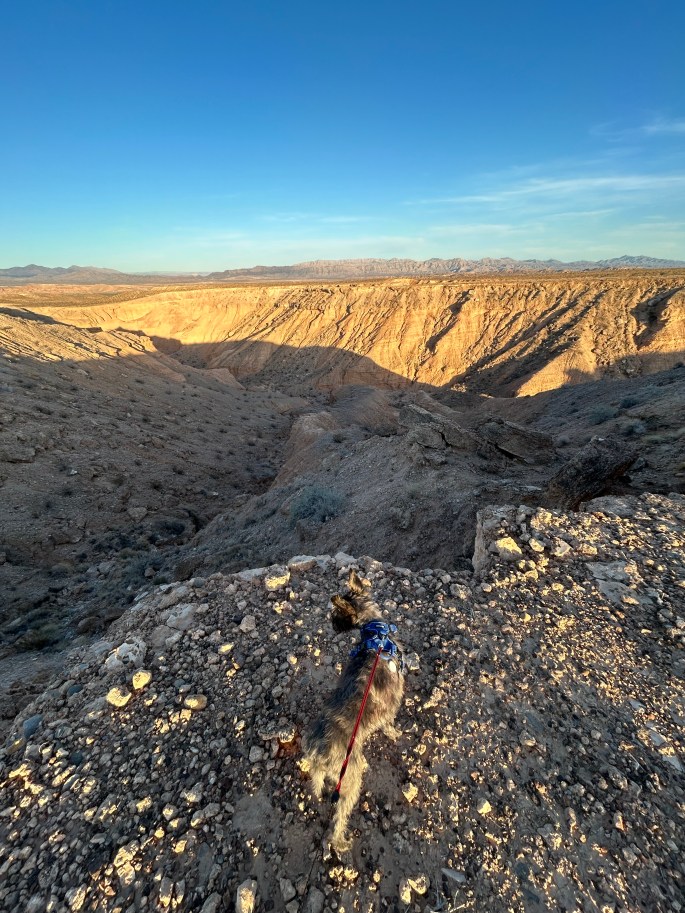
Senior miniature schnauzer standing near cliff edge with desert views at Poverty Flats

You know I was hella stressed about her sniffing this close to the edge.

My favorite thing about camping is waking up to amazing views, and Poverty Flats definitely didn’t disappoint.

Desert landscape at sunrise viewed from inside a truck camper

What a way to wake up!

I couldn’t get over how cool the landscape was, and how much it felt like I had it all to myself.

desert views truck camping at Poverty Flats BLM land

I mean, can you believe this!?

After feeding and taking care of Beatrix, we got out of there and headed down the road to Valley of Fire State Park.

Valley of Fire, Nevada’s first state park, was established in 1934 and covers more than 40,000 acres of Jurassic-era red sandstone and ancient limestone mountains. The area was once covered by an inland sea, which makes the views cool and surreal. No reservations are needed to visit the park, but you do need one if you want to camp there. It’s pretty popular, so book your trip in advance. They didn’t have any camping availability on the random Tuesday I was there. It costs $15 to enter the park (or $10 if you’re a Nevada resident).

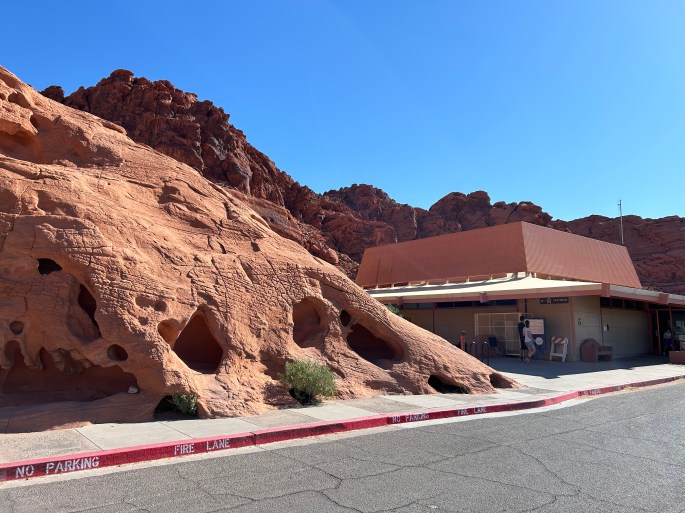
Exterior of Valley of Fire visitor center under clear blue sky

The visitor’s center has facilities you can use if you’ve been dispersed camping the night before without a bathroom! You can also fill your water bottle there.

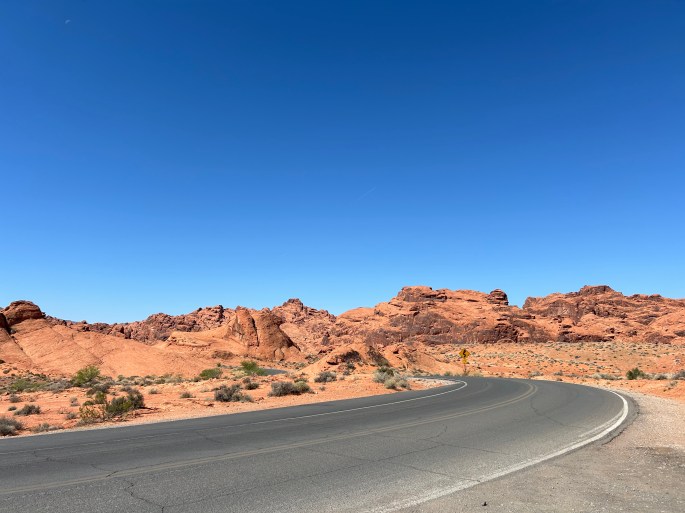
This is a fantastic park to drive through. While it’s dog friendly (as long as your furry friend is leashed), you know how Beatrix rolls: riding shotgun with the air conditioning on, living her best senior dog life. We don’t get out and hike most of the time, because she’s a delicate little old lady, so parks with amazing views you can see from the car are totally her jam.

Driving through Valley of Fire State Park in Nevada

Seriously, it’s a gorgeous drive.

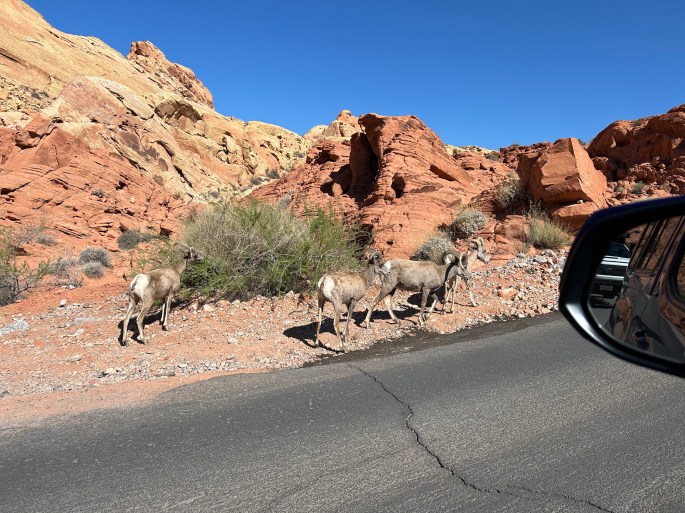
The park is full of desert bighorn sheep, which I was surprised to see are just chilling wherever!

Desert bighorn sheep grazing near the roadside in Valley of Fire State Park

All the cars slowed down to take a pic like this, these guys were unfazed.

I stopped at just about every place I could to take pics and enjoy the view. There were many shaded picnic areas that would be perfect for a break out of the sun for hikers and car travelers alike.

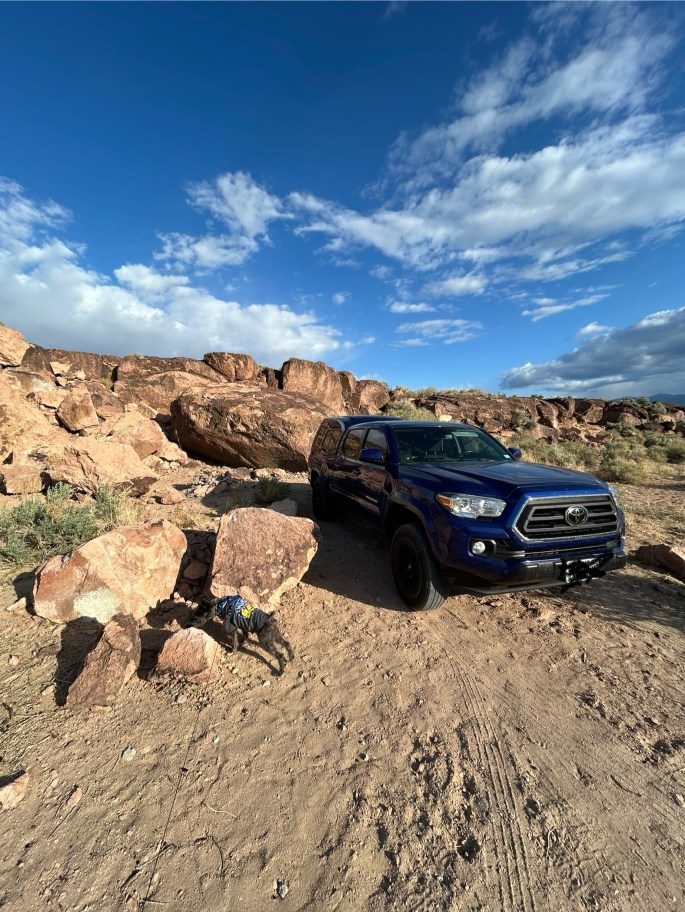
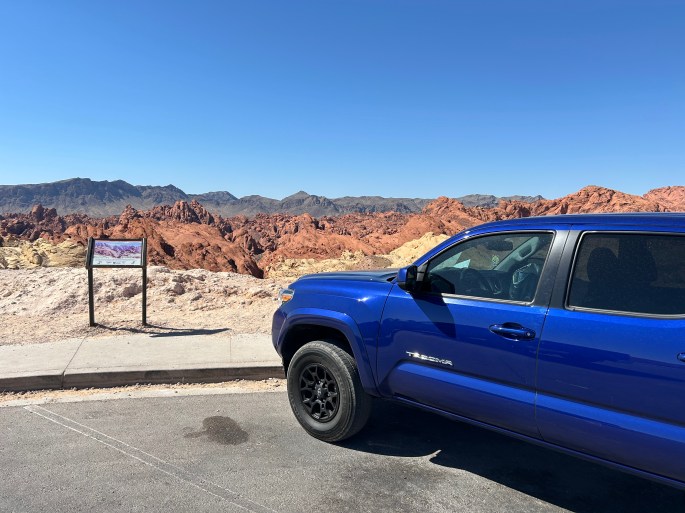
Toyota Tacoma at Fire Canyon in Valley of Fire State Park

Fire Canyon

Camper wearing Texas State Parks hat in front of Fire Canyon

Repping Texas State Parks with my hat, of course.

Valley of Fire has the most national park energy of any state park I’ve visited. Seriously, it’s stunning and otherworldly.

Seven Sisters rock formations

Seven Sisters rock formations.

At first I was disappointed that I wouldn’t be able to camp at the park, but staying at Poverty Flats and visiting the park in the morning was amazing. When I go back, I’m going to do the same thing again!

Have you ever tried dispersed camping? What was your first experience like? I’d love to hear your favorite free camping spots or Valley of Fire experiences in the comments!

5 (more) Things I Won’t Road Trip Without…and Neither Should Your Dog!

Preparing for my big cross-country road trip this spring has made me think hard about the best buys to make road-trip life easier with a special needs dog. This post goes beyond my top 5 tips for road-tripping with a dog. Some of these finds have made a huge difference in keeping my dog comfortable on the road!

Just because I’m currently in limbo while waiting for Leer to replace my 122 cap for my Tacoma doesn’t mean I can’t think ahead and plan while I wait! Here are some essentials I’ve learned about over the years that I won’t make a packing list without.

1. A Collar that Shines So Bright You’ll Need Shades

Beatrix wearing a glow-in-the-dark dog collar at night, standing on a sidewalk with the collar glowing brightly

You can see this collar from space!

This is probably the best and most convenient dog-related product I’ve found on Amazon. I get comments about it literally every time I walk Beatrix through our neighborhood. This light up collar keeps her visible when the sun sets and is an absolutely necessary item for her safety. Whether we’re on neighborhood streets where cars might come around the corner, or out in the wilderness, I never go for an evening walk without this collar.

My neighbor also has a light up leash like this one but I haven’t tried it yet. Have you?

2. This Cooling Mat Keeps You Chill…I May Have Bought This For Beatrix, But I’m the One Using It

Because Beatrix is elderly and has special medical needs, her comfort is the most important thing to me when we travel. I never want her to get too cold or get overheated. After one trip last spring where the heat was a little uncomfortable (and I spent the night intermittently fanning her with a large Texas state park map), I decided I needed something that could keep her cool all night. I found this dog cooling mat and immediately took it on our next trip.

I learned the hard way that Beatrix prefers fluffy over cool…she likes to sniff the cooling mat and then curl up on her bed instead. But honestly? I’ve ended up using it myself on hot nights, so it’s still a win!

3. A Portable Crate, Just in Case!

Beatrix is usually cuddled up in bed somewhere, but I’ve learned it’s smart to have a portable crate just in case. Whether we’re at an Airbnb or around other pets, it’s nice to have a secure spot for her to relax. A portable crate like this one is super helpful and folds up easily, so it’s not taking up precious trunk space. Better to have it and not need it than the other way around!

4. A Fluffy, Fuzzy, Familiar Bed from Home

Beatrix curled up and napping on a plush, pink dog bed at home

Beatrix’s bed is nicer than my mattress, tbh

I bought Beatrix this super soft and plush dog bed last Christmas and honestly, I wish they made them in people size. She absolutely loves curling up in it and napping. When you’re in a new place with your pup, it helps to have some familiar comforts of home, so this bed is definitely joining us on our next road trip.

5. Sun Protection Needed!

I still haven’t figured out this problem yet. I’d find there were times during our road trip last year that Beatrix was really in the sun, despite having tinted windows. To keep it from beating down on her, I tried to rig up my folding sunshade into a little sun barrier for her, but it was a pretty sad setup.

Beatrix sitting in the front seat of the car with a poorly positioned sunshade, looking unimpressed

Beatrix judging my sunshade setup like, is this the best you could do!?

This year, I’m looking for some better options, like these roll down mesh sunshades or this static cling sunshade option. Have you found any sunshades that work for your pet? Let me know, I’m taking suggestions!

These essentials have made a big difference for me and Beatrix on the road. If you’ve found any dog travel gear you swear by, drop a comment below. I’d love to hear about it! (Bonus points if it helps with sun protection as I’m still figuring that one out!)

How I Made My Tacoma Cooler with Tint…Literally

When I purchased my 2022 extended cab Toyota Tacoma, one of the first things I noticed was how blindingly bright it was inside the cab. Seriously, we’re talking surface of the sun here.

Me, trying not to get a sunburn.

Since Beatrix and I are planning lots of road trips, I knew I had to do something to control the temperature inside the truck and reduce the glare. Tinting the windows seemed like the perfect solution: cooler temps, more comfort, and some added privacy. So, I started researching Toyota Tacoma window tinting. First, I had to decide how much tint I needed. Car window tinting is measured in visible light transmission (VLT) percentage. These are the most common percentages to think about if you’re considering your Tacoma window tint options:

How Dark Should You Go?

70% VLT: 70% of light passes through the window tint. A super light tint that’s barely visible.

50% VLT: 50% of light passes through. It’s noticeably darker, but still pretty mild.

35% VLT: 35% of light passes through. This is ultimately what I went with; dark enough to reduce glare and heat, but not so dark my vision at night is obstructed.

20% VLT: Only 20% of light passes through, so this one is very dark. Think, tinted enough to make you feel mysterious.

5% VLT: Only 5% of all light passes through. This is limo tint and you can’t see in at all. Kind of tempting for privacy, but I knew I’d have a hard time seeing at all at night!

Be sure to check your state laws regarding window tint percentages, as every state is different in what is allowed!

Why 35% VLT was the Best Tint for My Tacoma

After some back and forth, I decided that 35% was the sweet spot for my Tacoma. It reduces heat and glare, adds privacy, and I’m not gonna lie, makes the truck look pretty sick. I considered going darker for privacy, but I wanted to make sure I could still see out at night without feeling like I was driving blind.

My Toyota Tacoma, Before and After Tinting

Here’s the truck before:

Before and after window tinting on Toyota Tacoma

You can see all the way through the front windows! Less than ideal for sneaking snacks at a red light.

Here’s the truck after:

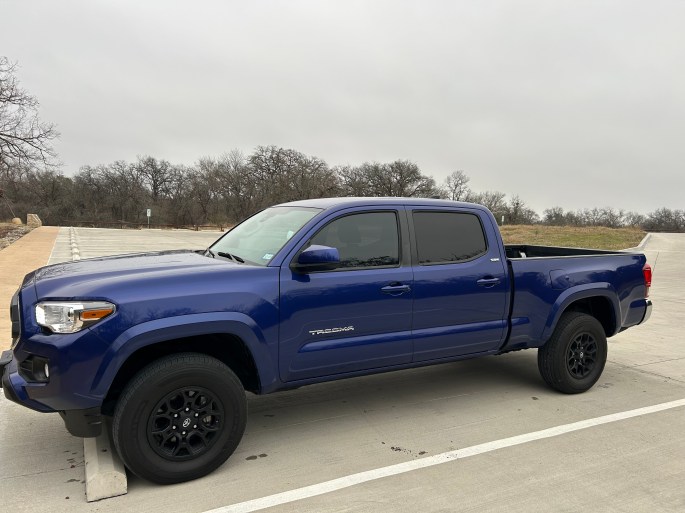
Toyota Tacoma with 35% window tint side view

Now we’re in stealth mode.

My Final Thoughts

I’m thrilled with how it turned out! Choosing 35% tint was the perfect balance between comfort, style, and visibility. If you’re considering Toyota Tacoma window tinting or wondering which tint level to choose, 35% might be the sweet spot for you too. No more squinting, and the cab feels way cooler (literally and figuratively). And most importantly, it’s Beatrix-approved.

Thinking about tinting your Tacoma? Drop a comment with your VLT choice or any questions! Do you think I made the right call?

Furry Co-Pilot Approved: 5 Must-Know Tips for Road-Tripping with Your Dog

My first road trips with my dog Beatrix weren’t exactly smooth…her water spilled and she didn’t always have the comfiest spot to curl up in. I figured out what works, though, and and now road-tripping with her is easy! Recently, a loved one was preparing to embark on a road trip with their dog and asked me for some advice. I decided to compile my best tips for traveling with a dog here! Be sure to read to the end of the post for advice specific to traveling with a special needs dog like Beatrix, who requires twice daily medication.

(This post contains affiliate links. If you click on a link and make a purchase, I may earn a small commission at no extra cost to you. Thank you for your support!)

1. Buckle Up, Pup! Keeping Your Dog Safe on the Road

It’s important to have your pup restrained when they’re riding in your vehicle. In the event of an accident, or even a situation where you have to unexpectedly slam on your brakes, you want to make sure your baby is as safe as possible! You wouldn’t drive without your seat belt, and neither should your pup.

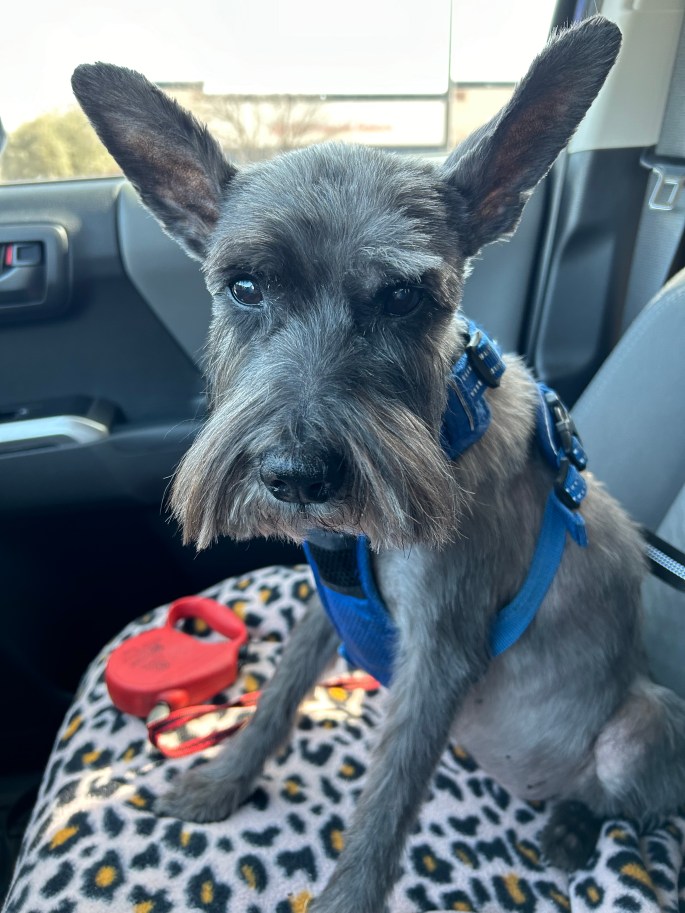
Beatrix locked and loaded

There are a lot of different dog restraint options out there, but my favorite is the doggy seat belt. I use a seat belt like this one. It’s secured around the headrest in the front seat and attaches to her harness, making sure she stays in place no matter what.

There are other, more elaborate dog restraint systems like this where you can secure your pup in the backseat, but I think Beatrix does better when she’s up front with me. She likes the near-constant head scratches, and I like being able to keep an eye on her.

2. Riding in Style: Making Your Dog’s Trip Comfy & Cozy

Putting a soft blanket down on the seat can make your dog feel comfy and at home. It especially helps protect them from leather seats that get hot in the summer as well as protects your seats from dirty puppy paw prints.

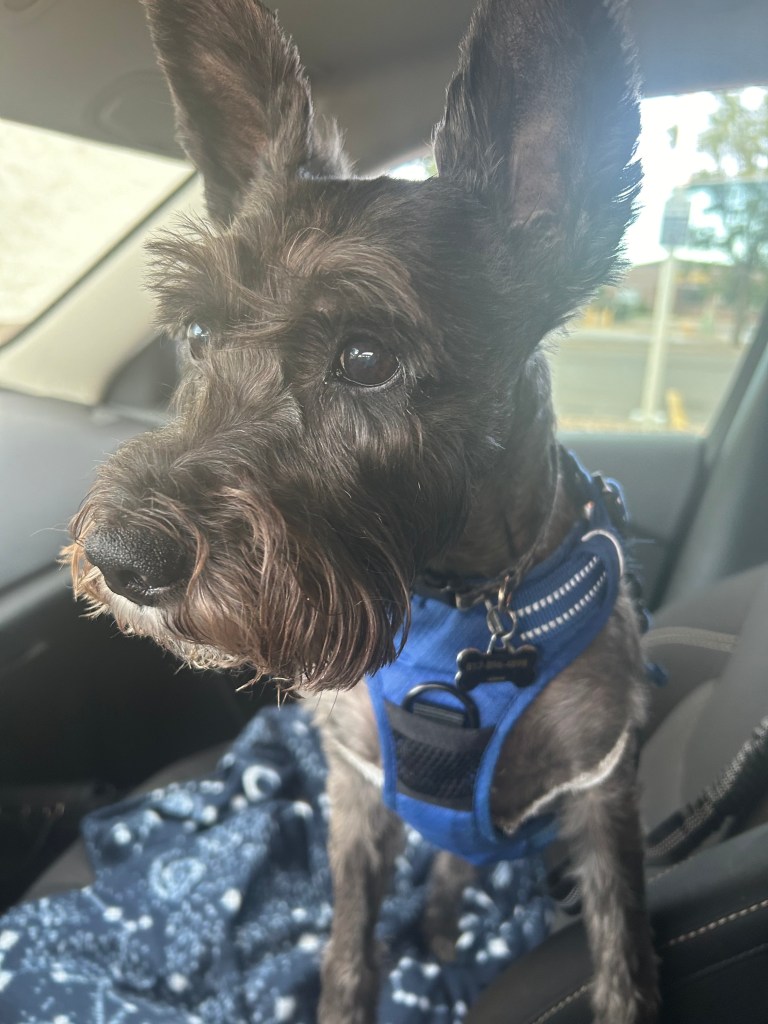
schnauzer with a harness in the car

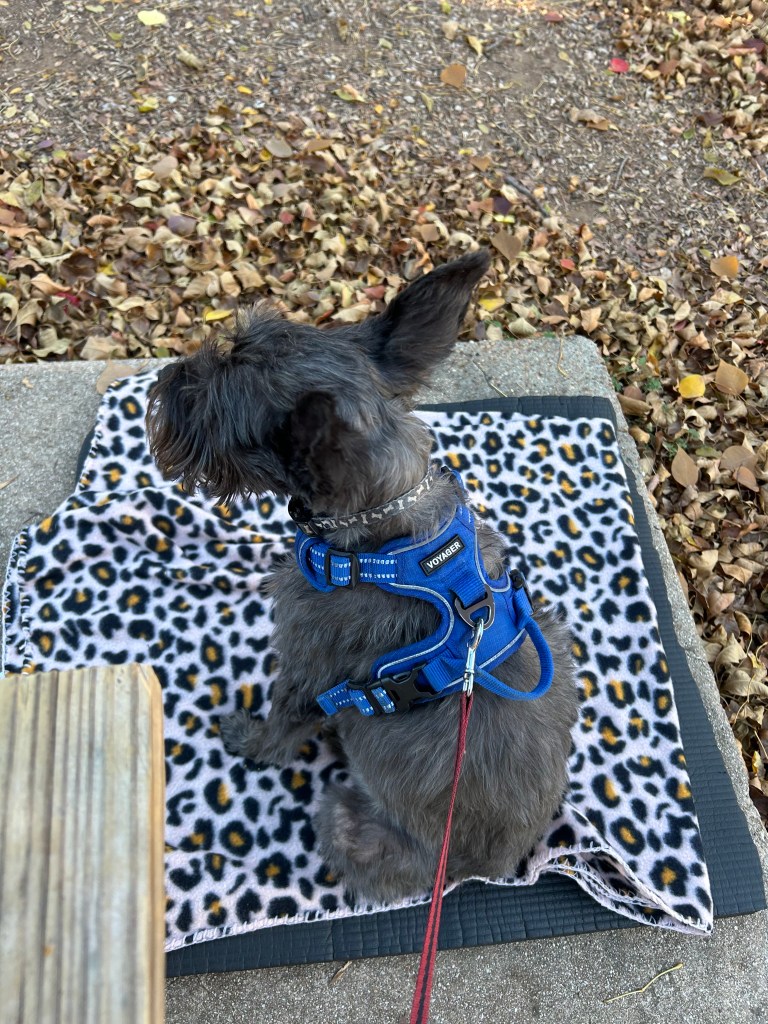
If you’re planning on stopping at a rest area to have a snack and take a break, it’s also nice to provide a comfy spot for your dog to rest. I have an old yoga mat I cut into pieces for Beatrix to lay on. I also use this camping pad sometimes.

Luxury road trip accommodations: Beatrix approved!

3. Hydration Station: Keeping Your Dog Cool and Refreshed

You want to be sure your dog stays hydrated during your trip. I have a collapsible bowl like this one that I toss on the floor of the front seat.

Avoid the temptation to leave water out while driving…it will spill. (Trust me, I’ve learned the hard way!)

It’s also helpful to keep a little bag of your dog’s favorite toys, treats, and poop bags right there in the front seat with you so you don’t have to dig for these things when you need them.

4. Pit Stops & Playtime: Planning Breaks for Both You and Your Dog

When I’m on a road trip, I try to keep both my needs and Beatrix’s in mind. We’ll both need to go to the bathroom and eat, I’ll need to fill the car up with gas, and she has to take her medication at specific times each day. It’s easier to try to make all these things happen at once rather than making multiple stops; that can make your trip feel like it’s lasting forever, in a bad way. Some gas stations like Love’s have a dog park area, which is helpful. I also like to find a place with a nice grassy area when I’m stopping for foods so I can walk her before I get my lunch.

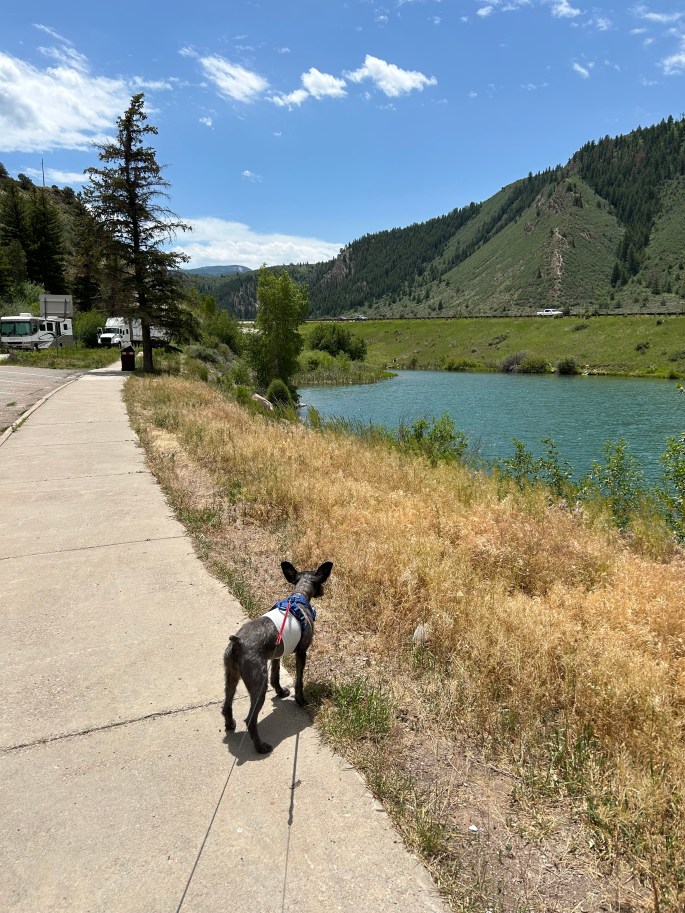
schnauzer making a pit stop in the Colorado mountains

Beatrix finding the perfect poo spot in this picturesque landscape.

Now, while planned stops are great, some of the best memories also come from those, “let’s just see what’s over there” moments. Take the scenic route and, if your dog is anything like Beatrix, they will love the extra sniffing time! We stopped at some roadside places in Colorado that were a gorgeous backdrop for a bathroom break.

5. Medicine on the Move: Keeping Special Needs Dogs Safe & Healthy

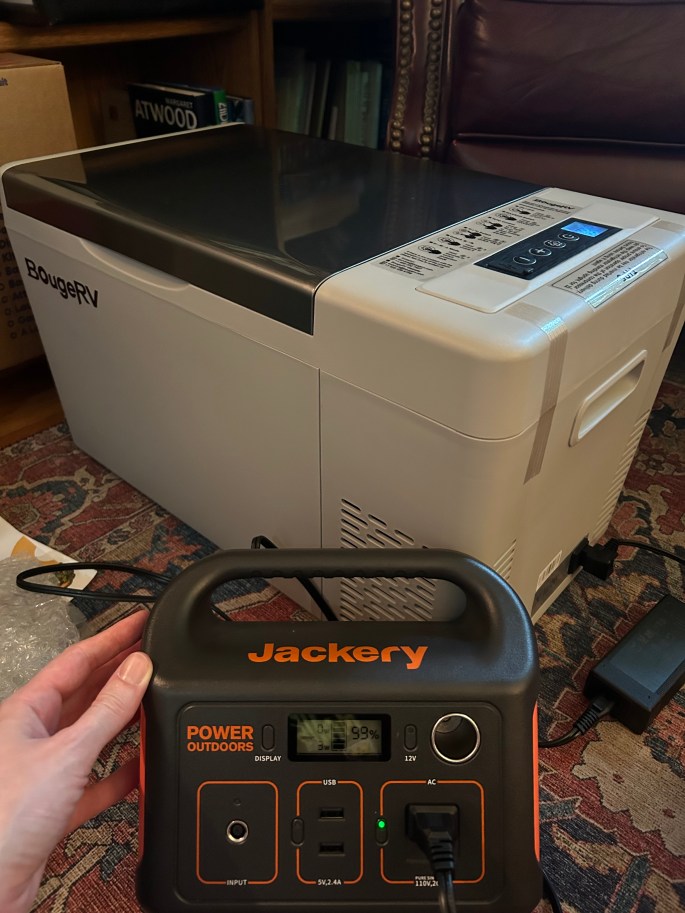
This tip is for your special needs pups like Beatrix. She receives an insulin injection twice a day that needs to be refrigerated. I like to use this fridge powered by this Jackery battery.

portable fridge and jackery battery to power it

It also pays off to think practically about the environment you’re administering your dog’s medication in. I’ve given Beatrix countless roadside and rest stop injections because our drive happens to fall during the time she needs her meds. I bought these little silicon insulin bottle protectors that prevent the glass bottle from breaking if I happen to drop it. It would be a nightmare to lose your dog’s meds by the side of the road when you’re far from home.

I hope these tips help you are you’re preparing to venture out on the road with your dog! Got any road trip rituals or must-have dog travel gear? Did I miss anything? Drop your favorite tips in the comments…I’d love to hear them!

This post contains affiliate links. If you click on a link and make a purchase, I may earn a small commission at no extra cost to you. Thank you for your support!

My No-Build Jeep Camping Setup: A Step-by-Step Guide

This post contains affiliate links. If you click on a link and make a purchase, I may earn a small commission at no extra cost to you. Thank you for your support!

My No-Build Jeep: Dependable and Fun
Just because I upgraded to a truck doesn’t mean you need a new vehicle to camp in comfort. For years, I made do with my trusty 2015 Jeep Cherokee, and with a few simple tweaks, you can turn almost any car into the perfect camping rig to live out your road-tripping dreams!
Beatrix and I have shared some amazing camping experiences in the Jeep. If it was up to me, I’d have kept the Jeep forever and just made it magically capable of holding more stuff. I loved the ease of folding the seats down and settling in with my dog curled up next to me as I lazed around at Texas State campgrounds, reading books and snacking the day away, just enjoying doing nothing.
This Jeep also took me over 5,000 miles the summer of 2024, across 6 states, through four national parks, and over endless miles of stunning scenery. It was reliable and comfortable, and I depended on it to keep me safe and happy. Almost any vehicle can be your perfect road trip rig if you keep an open mind.

Here’s a step by step guide to how I use my Jeep for camping.

Step 1: Create a Sleeping Space

By putting the seats down in the back I was able to create a sleeping space in my Jeep that was big enough for Beatrix and me. You’ll find a ton of info out there about building out sleeping platforms and things like that, and while I’ve done that for my truck to get some extra storage space beneath the bed, that’s not absolutely necessary for camping. Folding down your seats the old school way works just fine.

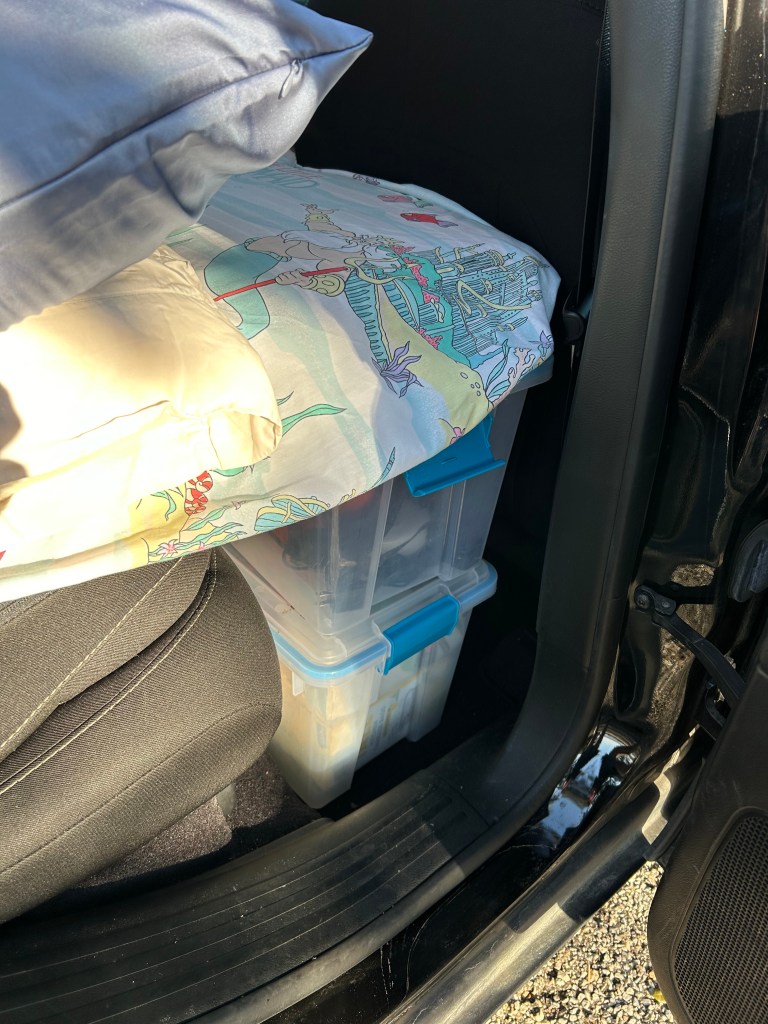
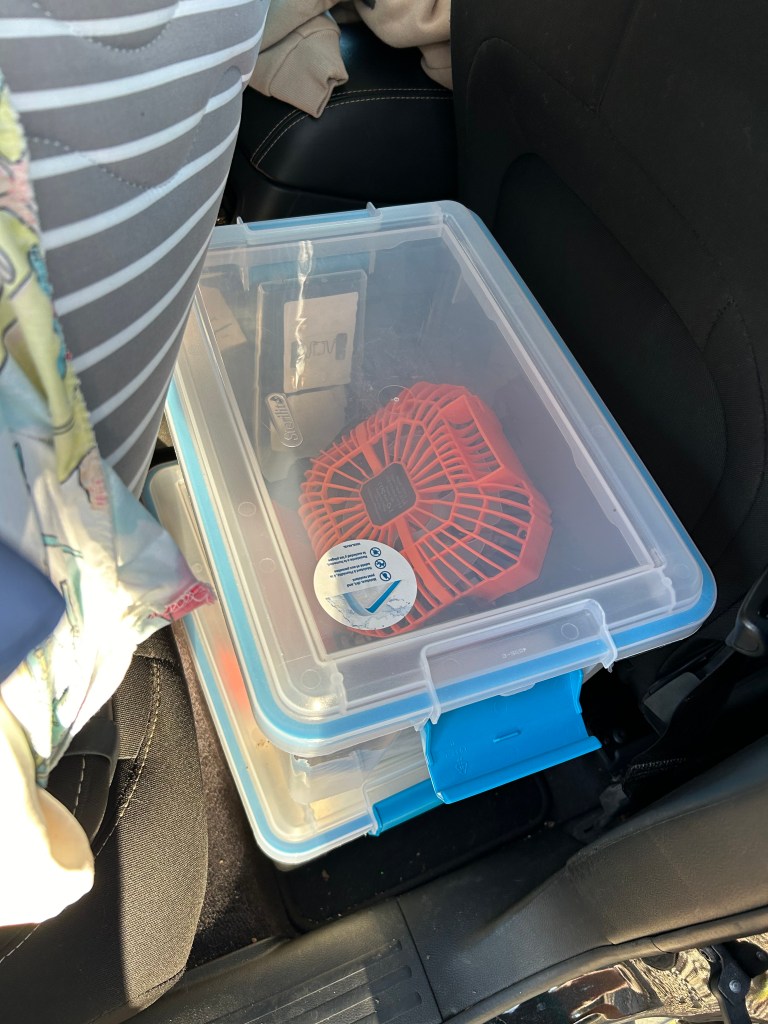
If your back seats don’t fold completely flat, you might need to fill the gaps for better support. I used plastic totes to create a level surface—and as a bonus, they double as storage!

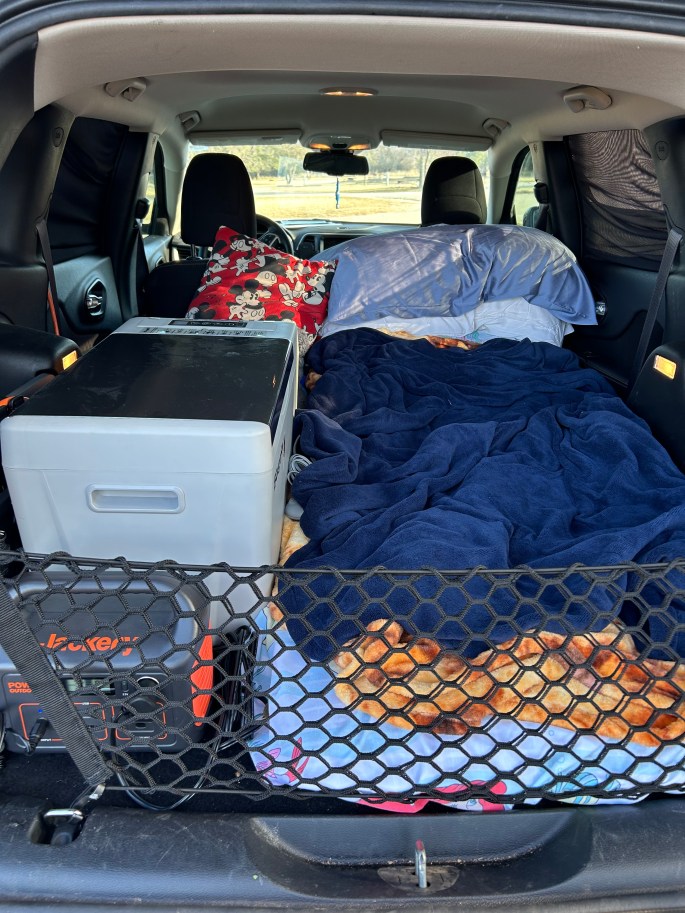
No build Jeep sleeping setup
The whole setup with the back seats folded down

These plastic totes fill the space between the seats so my sleeping pad is supported all the way across. I store my electronics in the top tote. Why yes, that is a vintage Little Mermaid bed sheet pilfered from my family linen closet!

Check out my comfort camping post to find out more about how I chose my mattress pad.

Step 2: You’ve Got to Have More Power!

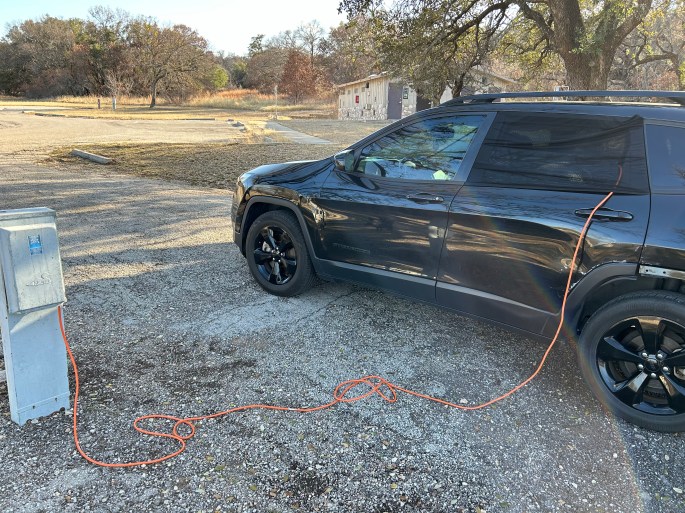
Power is essential to comfort camping. For trips at a powered state park site, I can rely 100% on this little Jackery battery. I plug an extension cord into the park’s shore power, and into the Jackery to power it, then I power everything else off of the Jackery. As you can see in the photo below, I have the extension cord plugged in to power the battery. The little fridge is charging off of the battery in the 12v spot. When I drive, I power the battery from the car, using the 12v connection in my trunk.

I just run the extension cord through my back window, which I leave open for airflow anyway, protected by a window screen (more info below).

Jackery powering no build Jeep setup

Here, the Jackery is being powered by shore power through the extension cord. While driving, I power it with the car through the 12v in the trunk, which you can see to the left. The fridge is plugged into the Jackery battery’s 12v spot.

Step 3: Figure Out Food Storage

Having a fridge really levels up your camping experience. It provides you with everything from cold drinks to leftovers you can simply transport and heat up over a small propane stove.

The number one reason I got a fridge was to transport Beatrix’s medicine, which has to be refrigerated. That’s why I’m so careful with making sure I have enough power all of the time, and why I usually choose powered campsites.

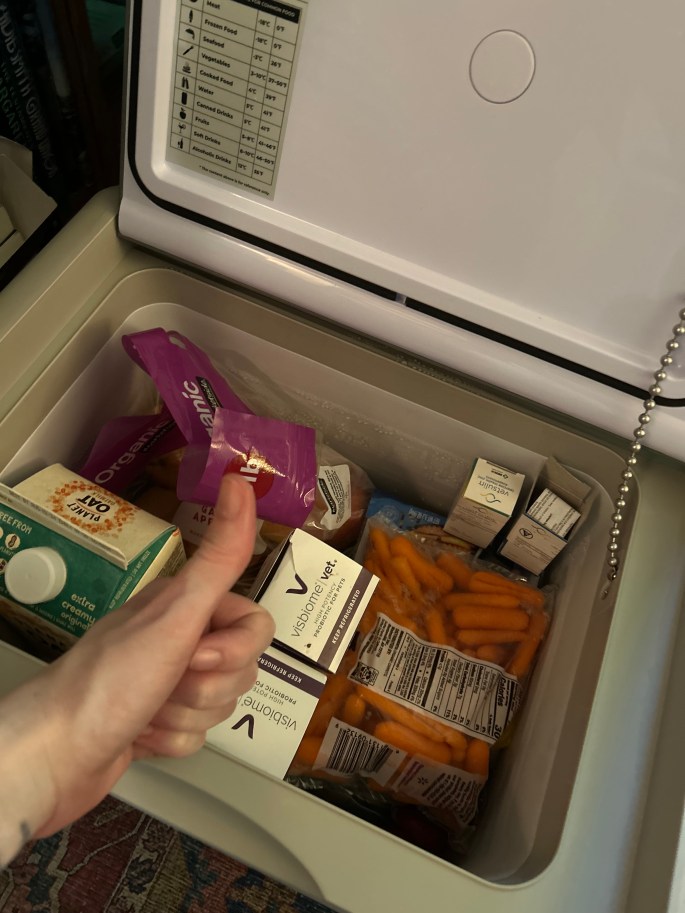
I’ve used this BougeRV fridge since last summer when we took our big cross-country road trip, and I love the little guy. It’s affordable and does a great job, and holds everything you need.

BougeRv fridge in no build Jeep setup

Getting my fridge packed up before my road trip last summer. As you can see, a whole oat milk and a giant bag of apples can fit in there, along with other snacks and my dog’s medication.

Step 4: Keep Safety and Privacy in Mind

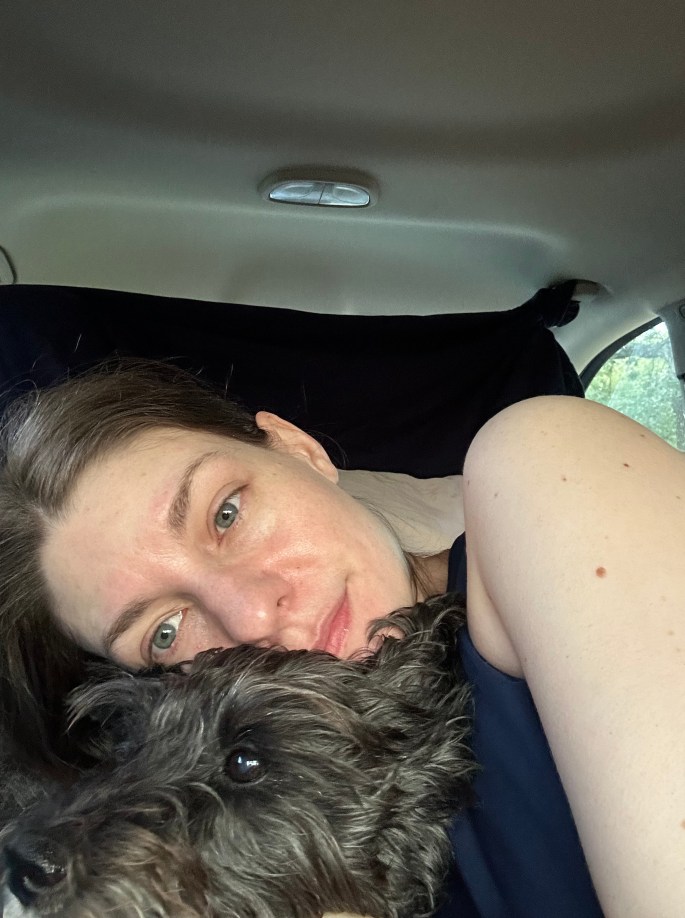
You don’t anyone walking by to just be able to peer in at you, you know? I swear, one of the easiest ways to create a little privacy is by hanging a simple bed sheet. I have a navy top sheet that lives permanently with my camping supplies and comes on every car camping trip with me.

A simple bed sheet does the trick.

As you can see, I just tie a corner of it it to each of the little handles and pull it tight (What are those little handles called? As a kid we called them “oh sh*t bars” but somehow I doubt that’s the technical term).

As you can also see, it’s not totally perfect. You can still see partway in. If you want to stealth camp at a truck stop I recommend something a little more substantial than tying a sheet to the “oh sh*t bars.” But I feel perfectly comfortable camping at Texas State Parks like this. Plus, you want a little bit of moonlight to be able to come through or how else are you going to bask like a nature witch bathing in the moonlight?

Keeping your windows down a bit is essential for airflow when the weather is warm. In fact, cracking your windows a bit is also essential even when it’s cool, so you don’t wake up with condensation all over the place (did you know you breathe out a ton of water when you sleep?)

But you still want some privacy and you absolutely do NOT want any bug in the vicinity to just be able to fly on in, so window screens are the perfect solution.

Gosh Beatrix, can you just not look like a hostage in my window screen pic? Kthanks.

I use window screens like this. They have a stretchy part at the bottom and you just pull them over the door frame.

Step 5: Temperature Control

Temperature control is essential to your comfort. I tend to avoid temperatures below the upper 30s and above, like, 70 degrees F. I find it a little easier to stay warm in cooler temps than to stay cool when it’s hot.

No matter what the forecast says, it’s a great idea to bring along a fan. I use this little USB rechargeable fan and it can make it through almost two whole nights on one charge. If you have to camp in warmer temps, then fans, parking in the shade, and reflective sunshades can help keep things cooler.

I also swear by a heated blanket, like this one. When I’m at a site with shore power, I simply plug it in to my Jackery. Electric blankets draw a lot of power though, and even with the Jackery plugged in and drawing charge all night, I’ll notice using the blanket drains my Jackery to 60 or 70% by the morning. However, Beatrix loves it on a chilly night, so it’s worth it! I’ve heard that 12v blankets use less electricity, so if I end up trying one of those, I’ll let you know how it goes.

Could you see yourself camping in a setup like this? Or do you have your own tricks for turning a car into a comfy camper? Let me know in the comments—I’d love to hear what works for you!