National Park Roundup: Driving Through Death Valley

Recap: I visited the country’s hottest and driest national park on a road trip with my dog, driving through miles of desolate, flat desert surrounded by mountain ranges. You can read about my experiences at Zion National Park with my dog here.

History

The national park, covering areas of California and Nevada, stretches over 5,000 square miles of the vast Death Valley. It was designated as a national monument in 1933. At that time the area contained the homeland of the Timbisha Shoshone Tribe, and a reservation was not designated for these people until 1982. Death Valley gained national park status in 1994.

The “Death” in Death Valley

Death Valley gets its spooky name from gold rush pioneers heading to California who thought the area would be their tomb in the winter of 1849. When they were rescued and leaving the area, one of them apparently said, “Goodbye, Death Valley,” and the name stuck.

People have lost their lives in the park, with the most common reason being vehicular accidents, and some people have lost their lives due to heat exposure. Temperatures in the hottest place on earth can soar as high as 120 degrees Fahrenheit, with the record high temperature reaching 134 degrees Fahrenheit.

Death Valley National Park thermometer

When I visited in April, it was only a cool 87 degrees.

Death Valley National Park Furnace Creek Visitor Center

Furnace Creek Visitor Center

Driving Through

Death Valley is a great national park for driving through. Its unique desert landscape stretches for miles, crossing some of the west’s most remote areas.

I entered Death Valley from the east, driving in from Las Vegas through Pahrump and Death Valley Junction, then continued west through Furnace Creek and Panamint Springs on my way to Bishop, California, which I wrote about here.

One famous site is Badwater Basin, which is 282 feet below sea level, consisting of nearly 200 square miles of salt flats made up of salt, calcite, gypsum, and borax. Tens of thousands of years ago this was the site of the ancient Lake Manly, which is now completely evaporated, leaving behind the Badwater Basin.

One of the most popular spots in the park to stop and take in the view is Zabriskie Point. This location is where you can access the start of the Badlands Loop Trail from the parking lot. I had initially put Zabriskie Point on my list to check out, but as I approached the area, I decided to just drive on past. It was pretty crowded, with a line of cars going in and out of the parking lot, and it was crawling with tourists. Not that I have anything against tourists…I realize that most places I go, I’m the tourist! But sometimes when I’m in the middle of a road trip like I was here, the thought of getting to my next stop is all the mental energy I have, and I just don’t want to take the time to futz with a busy crowd.

I did stop at the Father Crowley Vista Point with its views of Rainbow Canyon, where military fighter jets used to train. It’s located near the park’s western edge, overlooking Rainbow Canyon.

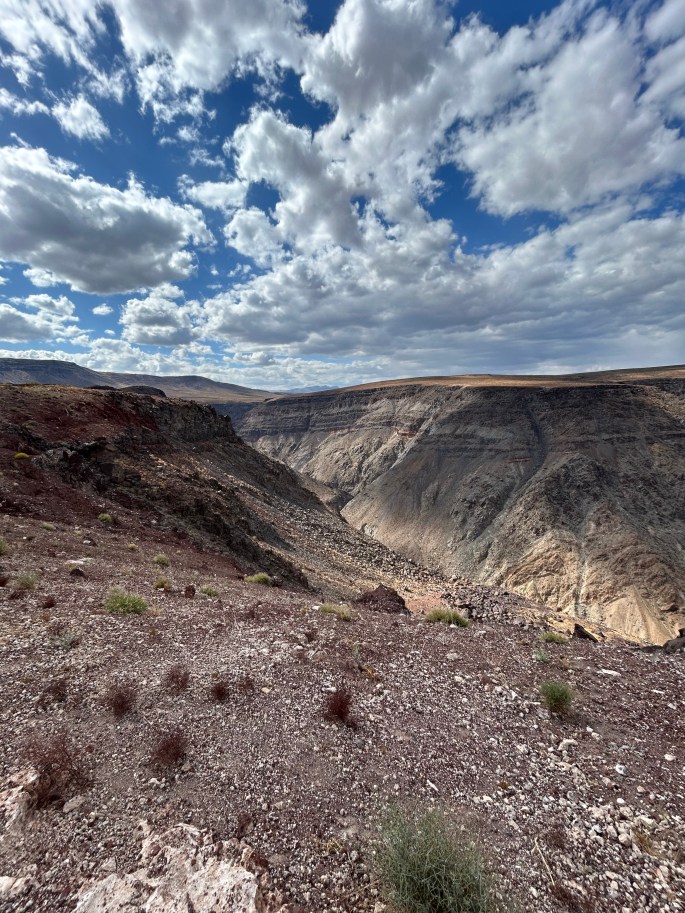
Rainbow Canyon at Death Valley National Park

Rainbow Canyon, also known as Star Wars Canyon, was once a training site for fighter jets.

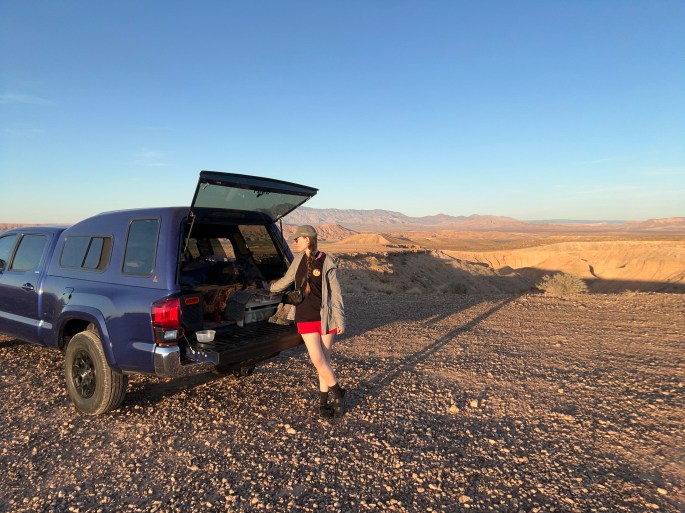
Toyota Tacoma at Father Crowley Vista Point at Death Valley National Park

My traveling Tacoma at Father Crowley Vista Point.

Dogs

Pets are not allowed on any trail in Death Valley NP. There are no dog-friendly hikes available in Death Valley. That works for me and Beatrix, because she’s a little old lady who doesn’t really go on hikes and is content to be a passenger princess for the duration. But for many people who have active dogs, this is limiting.

Like all national parks, dogs are allowed on parking lots and paved roads only.

The National Park Service published this list of roads near popular Death Valley sites where you can walk your dog.

Death Valley was a memorable drive through some gorgeous country, and I’m glad I passed through on my way to continue my road trip west!
National Park Roundup: Exploring Zion with my Dog

Recap: I explored Zion National Park with my dog, drove the scenic roads, and was tempted to join the boondockers camping just outside the park.

A Little History

Zion National Park, Utah’s first National Park, was established in 1919 by President Woodrow Wilson after first being protected as a national monument. It’s one of the most popular national parks; according to the National Park Service, attendance has increased 90% since 2010. In 2021, more than 5 million people visited the park, which is an impressive milestone few national parks ever reach.

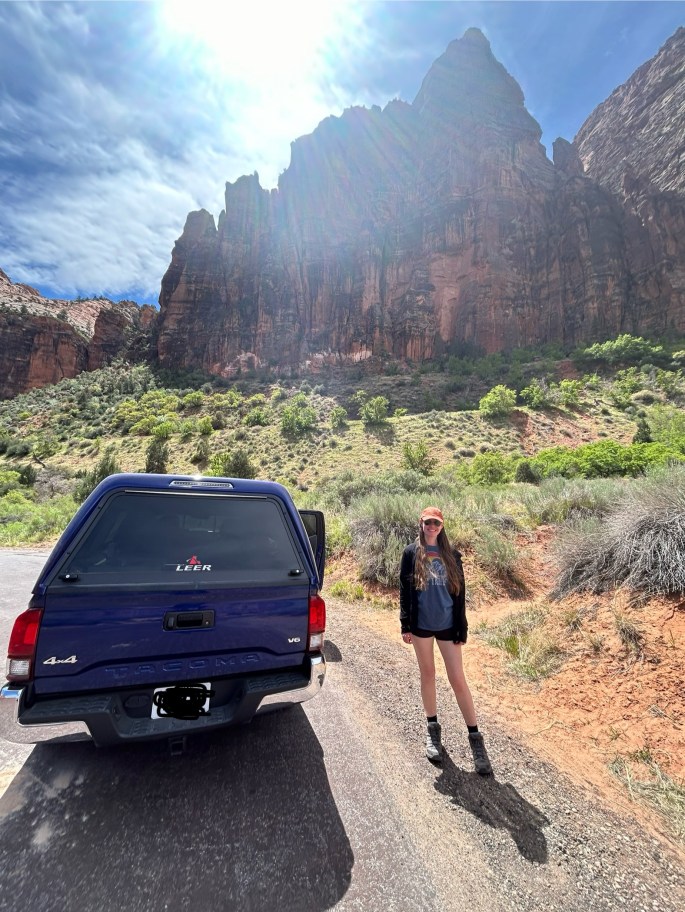
Traveler with Toyota Tacoma in front of Zion red rock cliffs

Zion’s red rock cliffs are breathtaking, even from the roadside.

How to Drive Through Zion (Even When Shuttles are Running)

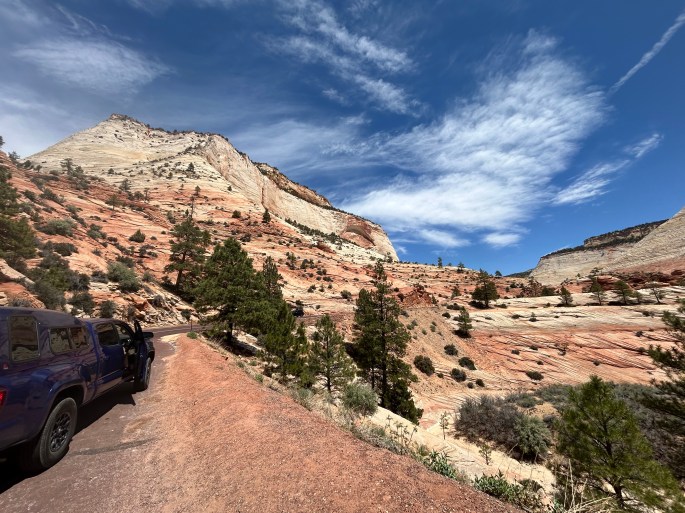
Zion Canyon Scenic Drive is closed to private vehicles when shuttles are running. Due to the enormous number of visitors to the park, a shuttle system is used to ensure as much access as possible. Most years the shuttles run from March to November, and for the holidays near the end of December. When I visited in April, this road was closed, and I couldn’t access that portion of the park. That means I missed out on famous sights such as the Narrows and Angels Landing.

Zion National Park road winding through red cliffs under blue sky

Even if you can’t drive through the whole thing, the views are still jaw-dropping.

Even when the shuttles are running, you can still drive through on the Zion-Mt. Carmel highway, the Zion-Mt. Carmel tunnel, Kolob Terrace Road, and Kolob Canyons Scenic Drive. While the tunnel accommodates most vehicles most of the time, oversized vehicles may need to apply for a special permit. I drove through the tunnel and it was very cool!

Zion National Park road winding through red cliffs under blue sky

Pull-off views like this make the drive unforgettable.

Visiting Zion with a Dog

Zion is not the easiest park to traverse with a dog. Like most national parks, dogs aren’t allowed in a majority of the park. They’re also not allowed on shuttles, so a whole section of the park is off-limits if you bring your furry friend.

Dogs are usually allowed in areas around national park visitor centers, and the same is true for Zion; dogs are allowed on the paved Pa’rus Trail that you can access from the visitor center. However, as Zion is an extremely popular destination, it can be difficult to even find a place to park at the visitor center to let your pup run around a bit. Beatrix and I finally did find a spot at the visitor center, but it was at the end of our excursion, after we’d already driven around most of the park. I stopped in briefly and picked up a park patch.

Zion Canyon Visitor Center building with red rock backdrop

Worth a stop if you can find parking!

I love a national park that allows you to see much of its beauty on a drive through. That’s probably the thing I value most when traveling with a dog. Another Utah-area park that I think is even better than Zion for driving through with a dog is Bryce Canyon. You can drive to almost any area in the park, and there are dozens of pull offs with gorgeous views. When I visit places like that, I tend to leave Beatrix in the truck, running with the air conditioner on of course, and dash out for some quick pics.

Selfie at Bryce Canyon, overcast skies

A rainy day during my visit in 2024 made Bryce Canyon even moodier and more magical.

Because I could only drive through some of Zion, I felt like I was missing out on a lot of what the park had to offer, and it’s on my list as a park I’d like to visit in the future if I’m making some dog-free trips. Still, if you’re in the area, and especially if you have a park pass, it’s definitely worth stopping by and checking out the majesty this place has to offer.

Where to Camp Near Zion

Camping is available within the park, but it can be difficult obtain a reservation, especially in peak season. If you’re like me, you’re always on the lookout for some free camping on BLM or National Park land anyway. Something I noticed as I approached the entrance to Zion were all of the boondockers parked throughout the beautiful lands surrounding the park. If I return, I’m definitely going to find some free camping in the area. The park’s boundaries certainly don’t enclose all of the unique beauty of the area, and there are plenty of quiet, scenic spots to camp outside the park boundaries.

Final Thoughts

Even though I couldn’t access the whole park with my dog, Zion’s drive-through beauty made it worth the visit. Next time, I might come back dog-free to hike The Narrows or Angel’s Landing…but for now, it’s a must-stop if you’re road-tripping through southern Utah.

Desert Magic: Homolovi State Park and Route 66 in Winslow, AZ

One of my favorite road trip stops this year was Homolovi State Park and Winslow, Arizona. It’s fairly close to Petrified Forest National Park, which we visited as well, and Flagstaff, Arizona. Winslow is on the old Route 66 and is an adorable small town with lots of charm. It sits roughly an hour west of Petrified Forest and an hour east of Flagstaff, making it a perfect midpoint stop.

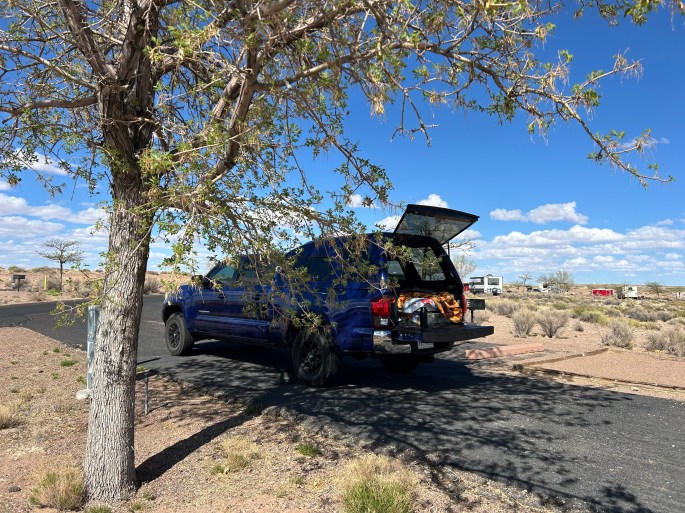
Beatrix and I checked in at Homolovi State Park on an April afternoon. The sun was shining brightly, but our camp spot was miraculously in the shade!

Toyota Tacoma parked under a small desert tree at Homolovi State Park campsite in Arizona

The traveling Tacoma makes it to Arizona!

We had a nice, slow afternoon, and I even realized the tent pad at our spot was the perfect place to put my yoga mat and do a little stretching. By that time we’d been on the road for a few days, and my body definitely felt it.

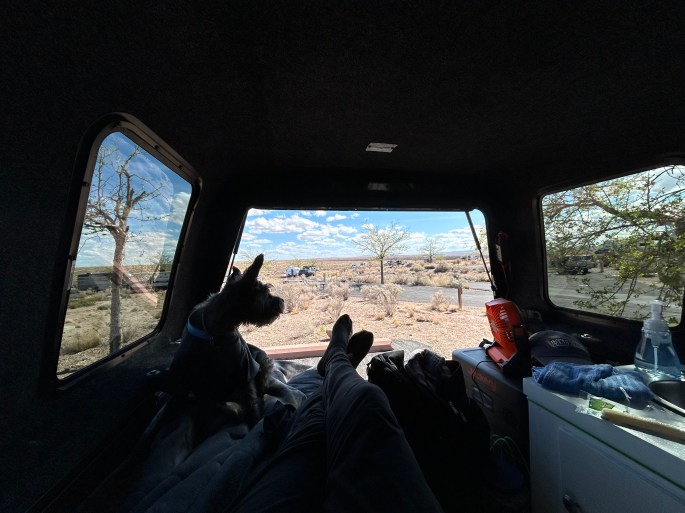
The weather was perfect in the shade, so Beatrix and I just kicked back and got some rest until it was time to make dinner.

View from the back of a truck camper with a mini schnauzer resting inside and desert landscape visible through the windows

Enjoying the quiet and the desert landscape.

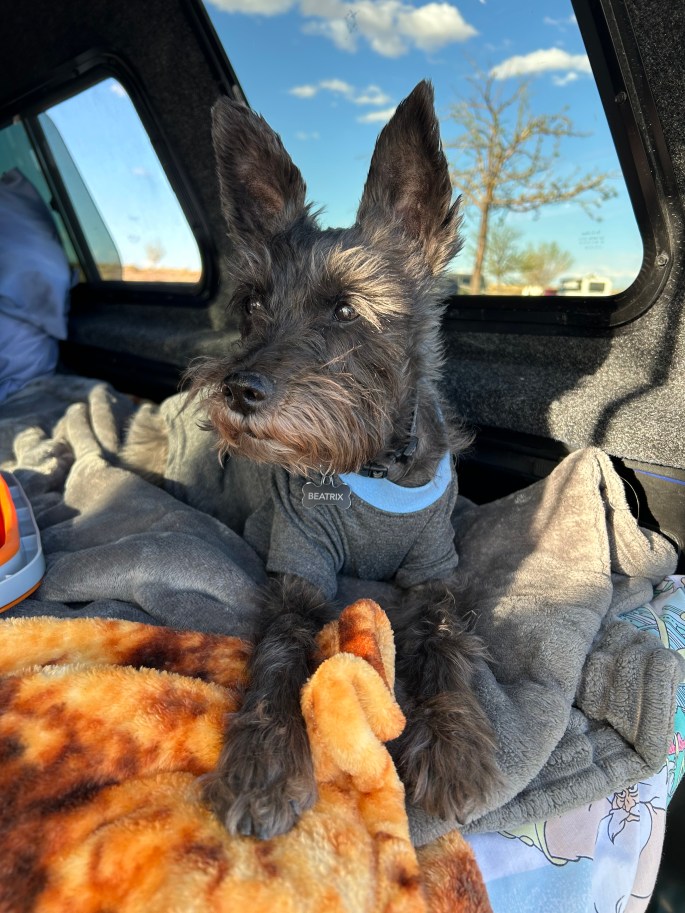
Mini schnauzer lounging in the back of a truck camper during a desert camping trip

Beatrix the mini schnauzer, camping goddess.

At first there weren’t too many other campers, but as it got close to evening, the campgrounds filled up and every spot was taken. I had made a reservation in advance, which I highly recommend for this park; it’s in demand.

There are some major upsides to campgrounds, such as a built-in sense of security (whether true or not) and access to trash and bathrooms. In fact, I usually try to get a spot really close to the bathrooms so I can easily take bathroom breaks and brush my teeth, even though I have a sink in my build. It helps save my water, and it’s always a plus when you can actually flush a toilet. But there are downsides, too. It did feel a little cramped with everyone in there, although most people really keep to themselves. But it can feel a little weird doing all my leg stretching yoga poses and downward dog in full view of like a dozen RVs.

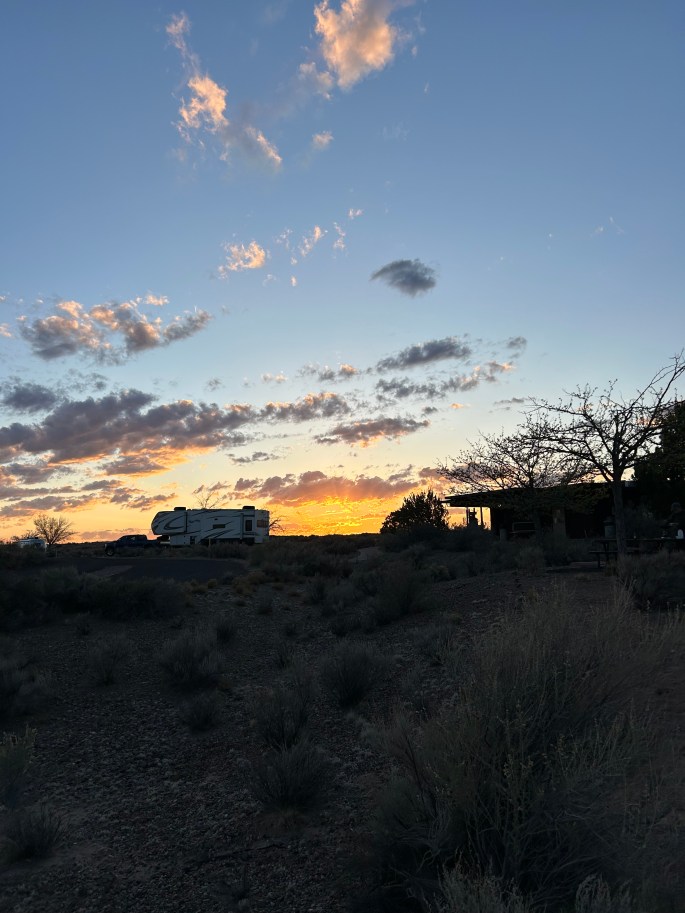
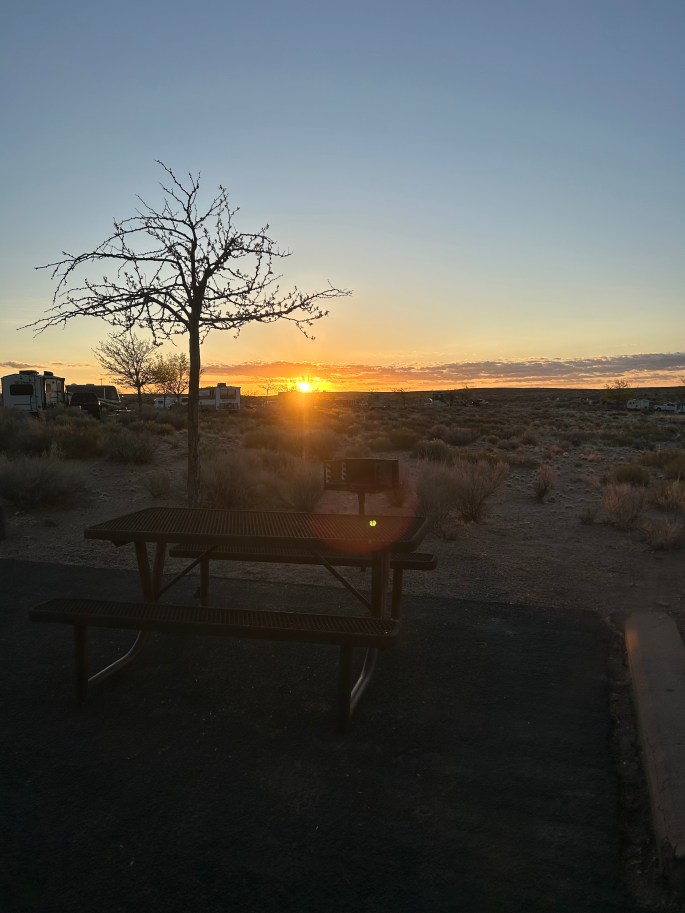
When sunset began, I was speechless.

Glowing golden sunset over the flat Arizona desert at Homolovi State Park

Just breathtaking!

I was really mesmerized by the bright golden light. There is something so beautiful about the flat, vast desert and the endless sky. I’ve always thought tall trees and mountains were my favorite, but doing some desert camping this year has made me change my mind. When it’s not oppressively hot, the desert is one of the most magical places to be.

The sunrise was gorgeous too! The sunlight poured into my truck.

Early morning desert sunrise casting warm light over Homolovi State Park campground

It really got me up bright and early!

There are two historical sites at Homolovi State Park featuring the ruins of native structures. According to the official Homolovi State Park website, “Homolovi” is Hopi for “place of the little hills.” The Hisat’sinom, or ancestral Puebloan people, migrated through this area on the way to join the people now known as the Hopi. This area is considered sacred to the Hopi.

I didn’t visit the ruins because my priority when I travel is Beatrix, first and foremost. I don’t like her to get out in the direct sun, and I try to minimize the time I just leave her in the car with the engine running as much as possible, especially in warm places like Arizona. But I’m also torn on seeing some of these things. I feel like such a colonizer tourist traipsing around the remains of a sacred place that was once the homeland of a thriving and ancient culture. Of course, I also think it’s important as a tourist to remember these places and sit with that discomfort as well.

Through the course of my traveling, I’ve realized that some of the most beautiful places I’ve visited are on the grounds of stolen land. I’ve been thinking about doing a deeper post just about that, so stay tuned.

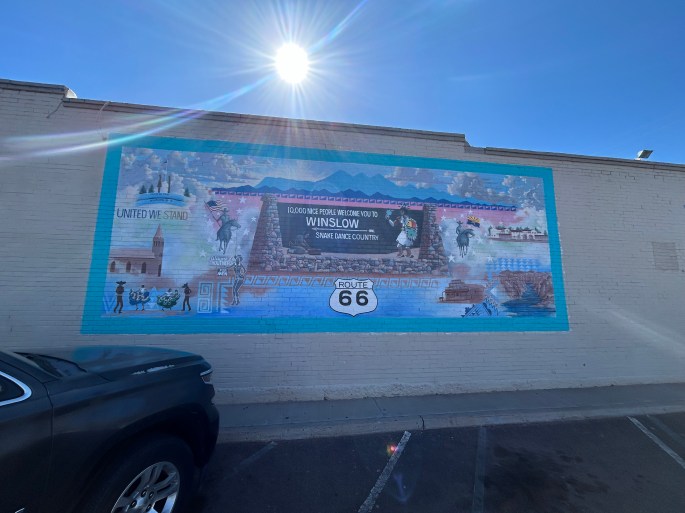
After leaving the state park, Beatrix and I stopped in at the little town of Winslow to get some gas. It’s a small, slow, cool little town, kind of like Bishop, California, which I talked about in my last post.

Mural reading “10,000 nice people welcome you to Winslow” painted on a brick building in Winslow, Arizona

Welcome to Winslow!

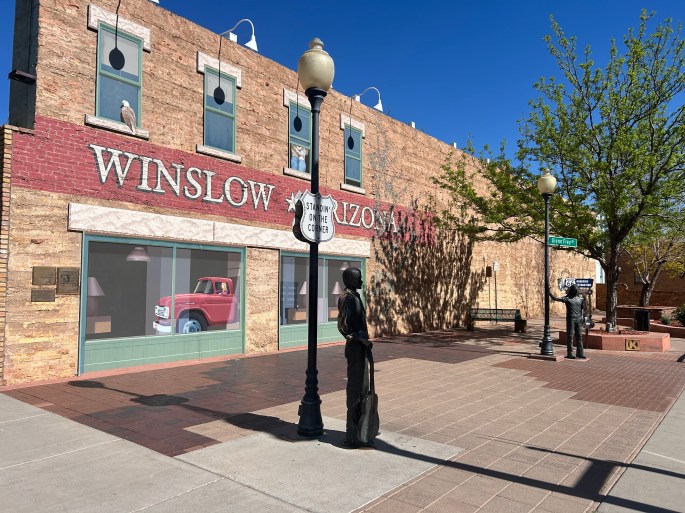
I noticed some signs for Standin’ on the Corner Park, from the famous line from the Eagles song, so I had to make a quick stop.

The “Standin’ on the Corner” statue and mural tribute in downtown Winslow, Arizona on Route 66

Standin’ on the corner in Winslow, Arizona.

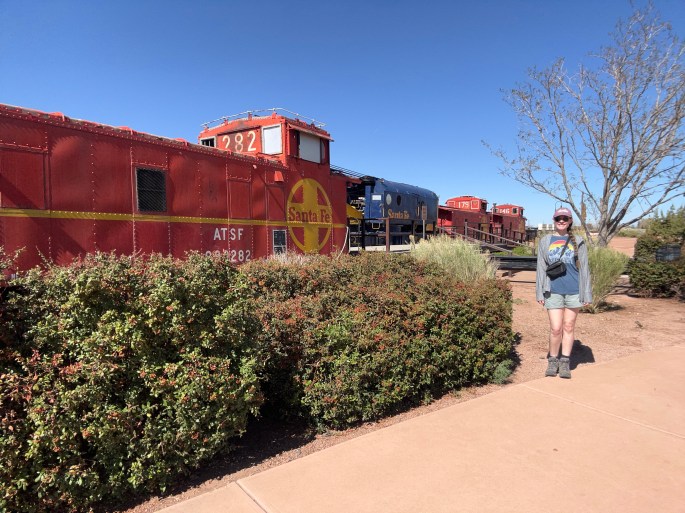
Right near the corner, I spotted a massive vintage Santa Fe train on display, so of course I had to grab a photo!

Traveler standing in front of a vintage Santa Fe locomotive on display in Winslow, Arizona

Classic train moment!

One thing I noticed while driving through all of that big, gorgeous Arizona desert was there are trains everywhere out there. Of course I had to take a pic in front of one when I could! After a peaceful night in the desert and a quick corner stop in Winslow, we were back on the road, next stop: Nevada.

First Time Dispersed Camping: Poverty Flats near Valley of Fire State Park

Previously on Just Get Outside, I was preparing for my next cross-country road trip and praying my Leer cap would come in on time. I stayed at some beautiful campgrounds along the way, and I’ll definitely share those soon, but let’s start with my first ever experience with dispersed camping at Poverty Flats outside of Las Vegas, Nevada!

Toyota Tacoma with camper setup parked on open BLM land at Poverty Flats near Valley of Fire State Park

Spoiler alert: my truck cap came in on time!

I was halfway through my trip from Texas to Oregon before I tried dispersed camping for the first time. I had great experiences at established campgrounds in Texas, New Mexico, and Arizona, but I was ready to push myself outside of my comfort zone a little bit. I knew I wanted to see the famous Valley of Fire State Park in Nevada, but they didn’t have any camp sites available in the park during the time I would be there, so I explored my options for dispersed camping.

Dispersed camping means free camping on public land that’s usually managed by the National Forest Service or the Bureau of Land Management (BLM). It’s a popular choice for boondockers, vanlifers, and road trippers looking to save money and enjoy some solitude. Some of the benefits of dispersed camping are that it’s free, and it’s usually much more private than being slotted into a campground just feet from your nearest RV neighbor. Some of the downsides are that it doesn’t have facilities like toilets and water, so you have to make sure you come prepared.

Poverty Flats is about an hour’s drive outside of Vegas and only about a 10 minute drive from Valley of Fire. The April weather was beautiful and it seemed like the perfect spot to try dispersed camping for the first time.

I arrived just before sunset and bounced slowly down the gravel roads, stoked to use my 4×4 for the first time. There were other campers and RVs set up, and I made my way past them to my own spot. I was a little nervous about knowing where I was actually allowed to camp, but there are tons of already established spots out there. You can usually tell when it’s an established spot because it has a fire ring and other indications people have camped there.

Toyota Tacoma with camper setup parked on open BLM land at Poverty Flats near Valley of Fire State Park

Settling in my home away from home!

I found a fire ring and got settled. I took Beatrix out for a stroll and marveled at the views. It was vast and open and I felt like I could see for miles. Even though we weren’t parked right next to anyone, knowing other campers were fairly close by made me feel at ease without losing that peaceful, wide-open feeling. I was out there for about 10 minutes when I realized dispersed camping would be my first choice over established campgrounds from now on.

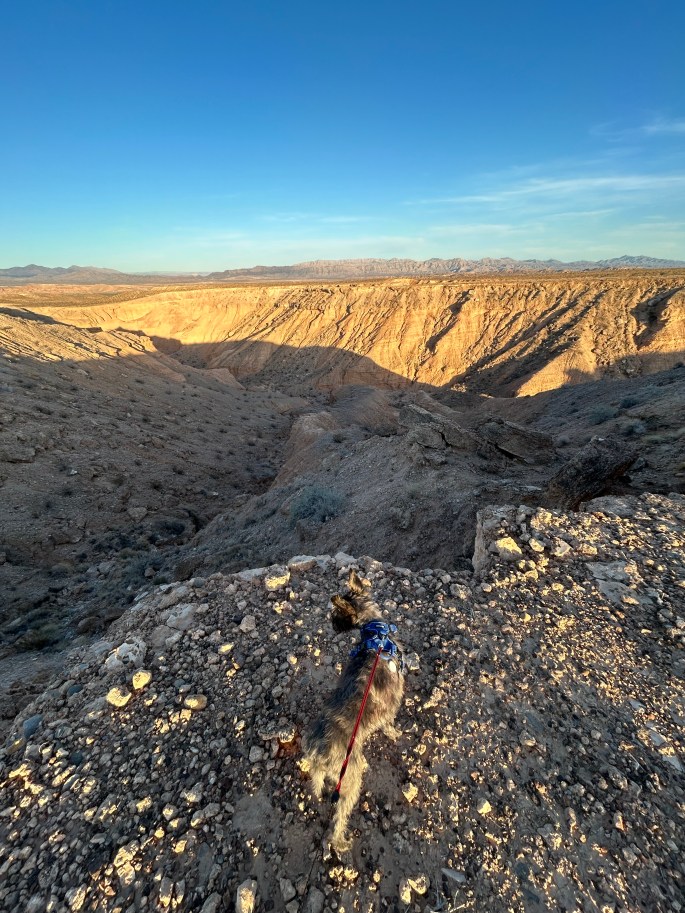
Senior miniature schnauzer standing near cliff edge with desert views at Poverty Flats

You know I was hella stressed about her sniffing this close to the edge.

My favorite thing about camping is waking up to amazing views, and Poverty Flats definitely didn’t disappoint.

Desert landscape at sunrise viewed from inside a truck camper

What a way to wake up!

I couldn’t get over how cool the landscape was, and how much it felt like I had it all to myself.

desert views truck camping at Poverty Flats BLM land

I mean, can you believe this!?

After feeding and taking care of Beatrix, we got out of there and headed down the road to Valley of Fire State Park.

Valley of Fire, Nevada’s first state park, was established in 1934 and covers more than 40,000 acres of Jurassic-era red sandstone and ancient limestone mountains. The area was once covered by an inland sea, which makes the views cool and surreal. No reservations are needed to visit the park, but you do need one if you want to camp there. It’s pretty popular, so book your trip in advance. They didn’t have any camping availability on the random Tuesday I was there. It costs $15 to enter the park (or $10 if you’re a Nevada resident).

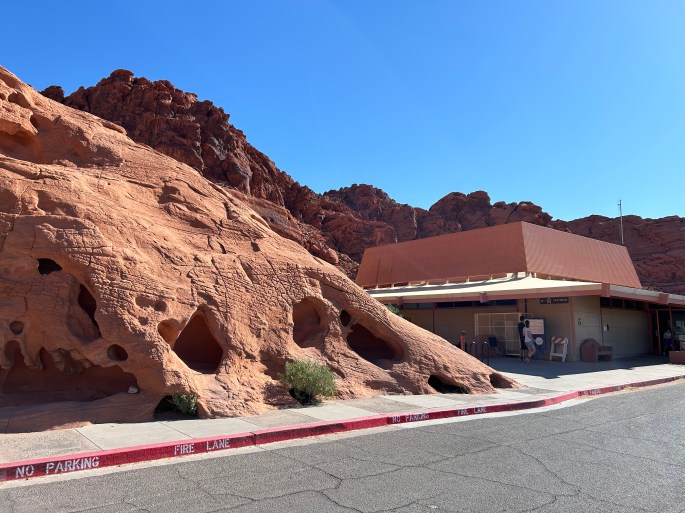
Exterior of Valley of Fire visitor center under clear blue sky

The visitor’s center has facilities you can use if you’ve been dispersed camping the night before without a bathroom! You can also fill your water bottle there.

This is a fantastic park to drive through. While it’s dog friendly (as long as your furry friend is leashed), you know how Beatrix rolls: riding shotgun with the air conditioning on, living her best senior dog life. We don’t get out and hike most of the time, because she’s a delicate little old lady, so parks with amazing views you can see from the car are totally her jam.

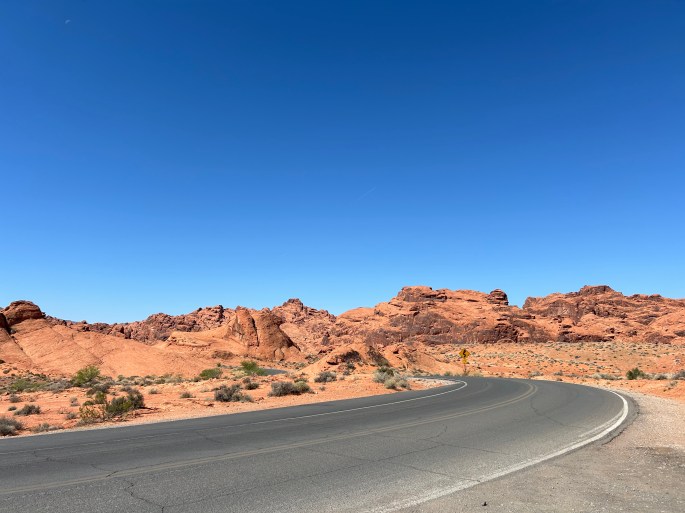
Driving through Valley of Fire State Park in Nevada

Seriously, it’s a gorgeous drive.

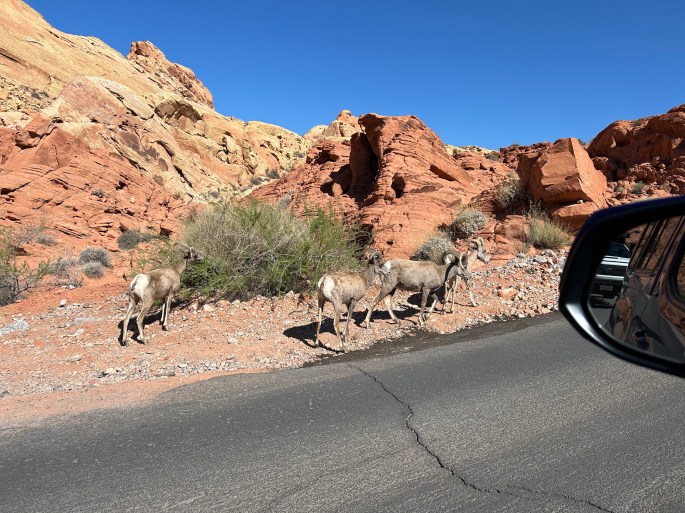
The park is full of desert bighorn sheep, which I was surprised to see are just chilling wherever!

Desert bighorn sheep grazing near the roadside in Valley of Fire State Park

All the cars slowed down to take a pic like this, these guys were unfazed.

I stopped at just about every place I could to take pics and enjoy the view. There were many shaded picnic areas that would be perfect for a break out of the sun for hikers and car travelers alike.

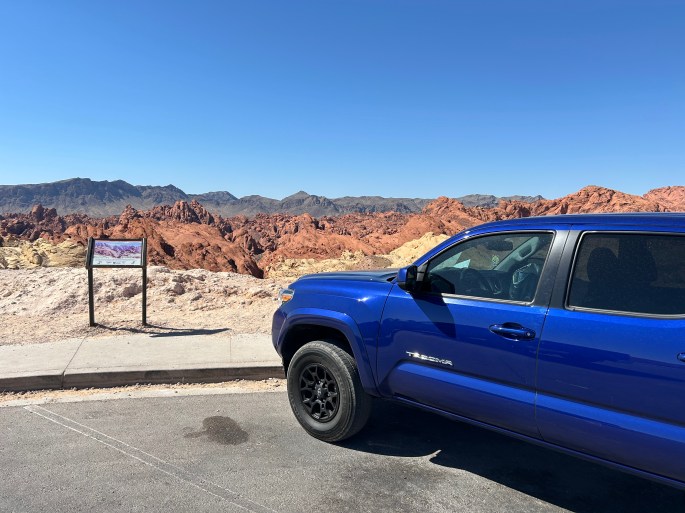
Toyota Tacoma at Fire Canyon in Valley of Fire State Park

Fire Canyon

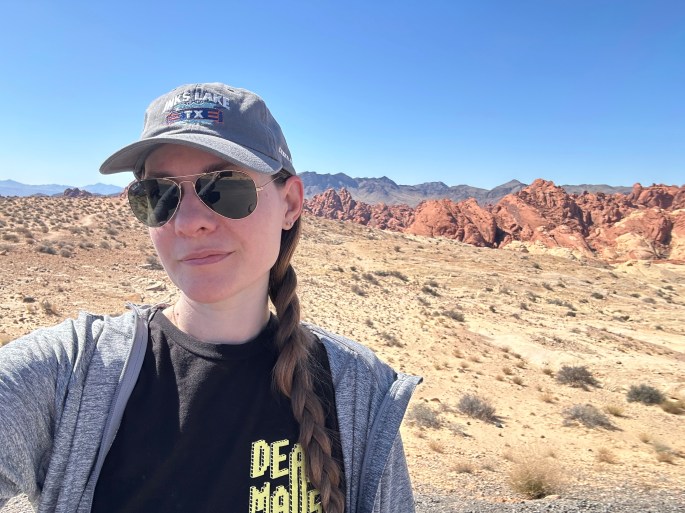
Camper wearing Texas State Parks hat in front of Fire Canyon

Repping Texas State Parks with my hat, of course.

Valley of Fire has the most national park energy of any state park I’ve visited. Seriously, it’s stunning and otherworldly.

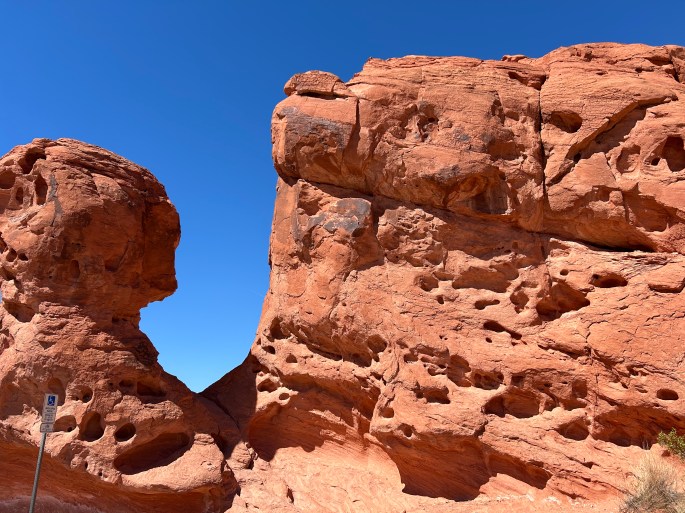
Seven Sisters rock formations

Seven Sisters rock formations.

At first I was disappointed that I wouldn’t be able to camp at the park, but staying at Poverty Flats and visiting the park in the morning was amazing. When I go back, I’m going to do the same thing again!

Have you ever tried dispersed camping? What was your first experience like? I’d love to hear your favorite free camping spots or Valley of Fire experiences in the comments!

How I Made My Tacoma Cooler with Tint…Literally

When I purchased my 2022 extended cab Toyota Tacoma, one of the first things I noticed was how blindingly bright it was inside the cab. Seriously, we’re talking surface of the sun here.

Me, trying not to get a sunburn.

Since Beatrix and I are planning lots of road trips, I knew I had to do something to control the temperature inside the truck and reduce the glare. Tinting the windows seemed like the perfect solution: cooler temps, more comfort, and some added privacy. So, I started researching Toyota Tacoma window tinting. First, I had to decide how much tint I needed. Car window tinting is measured in visible light transmission (VLT) percentage. These are the most common percentages to think about if you’re considering your Tacoma window tint options:

How Dark Should You Go?

70% VLT: 70% of light passes through the window tint. A super light tint that’s barely visible.

50% VLT: 50% of light passes through. It’s noticeably darker, but still pretty mild.

35% VLT: 35% of light passes through. This is ultimately what I went with; dark enough to reduce glare and heat, but not so dark my vision at night is obstructed.

20% VLT: Only 20% of light passes through, so this one is very dark. Think, tinted enough to make you feel mysterious.

5% VLT: Only 5% of all light passes through. This is limo tint and you can’t see in at all. Kind of tempting for privacy, but I knew I’d have a hard time seeing at all at night!

Be sure to check your state laws regarding window tint percentages, as every state is different in what is allowed!

Why 35% VLT was the Best Tint for My Tacoma

After some back and forth, I decided that 35% was the sweet spot for my Tacoma. It reduces heat and glare, adds privacy, and I’m not gonna lie, makes the truck look pretty sick. I considered going darker for privacy, but I wanted to make sure I could still see out at night without feeling like I was driving blind.

My Toyota Tacoma, Before and After Tinting

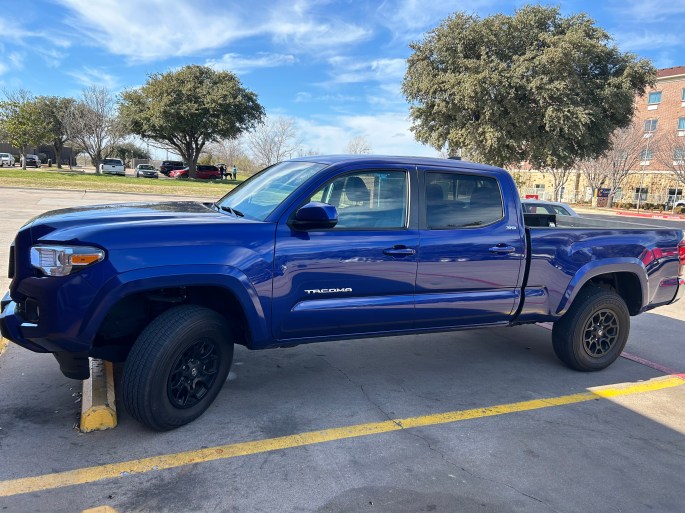
Here’s the truck before:

Before and after window tinting on Toyota Tacoma

You can see all the way through the front windows! Less than ideal for sneaking snacks at a red light.

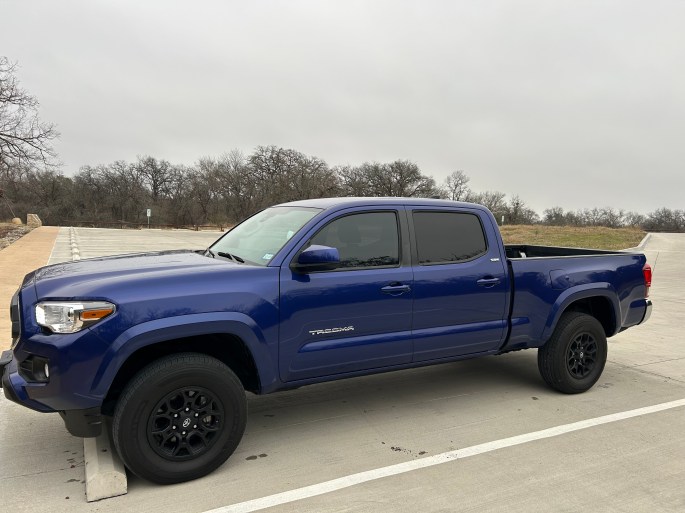
Here’s the truck after:

Toyota Tacoma with 35% window tint side view

Now we’re in stealth mode.

My Final Thoughts

I’m thrilled with how it turned out! Choosing 35% tint was the perfect balance between comfort, style, and visibility. If you’re considering Toyota Tacoma window tinting or wondering which tint level to choose, 35% might be the sweet spot for you too. No more squinting, and the cab feels way cooler (literally and figuratively). And most importantly, it’s Beatrix-approved.

Thinking about tinting your Tacoma? Drop a comment with your VLT choice or any questions! Do you think I made the right call?